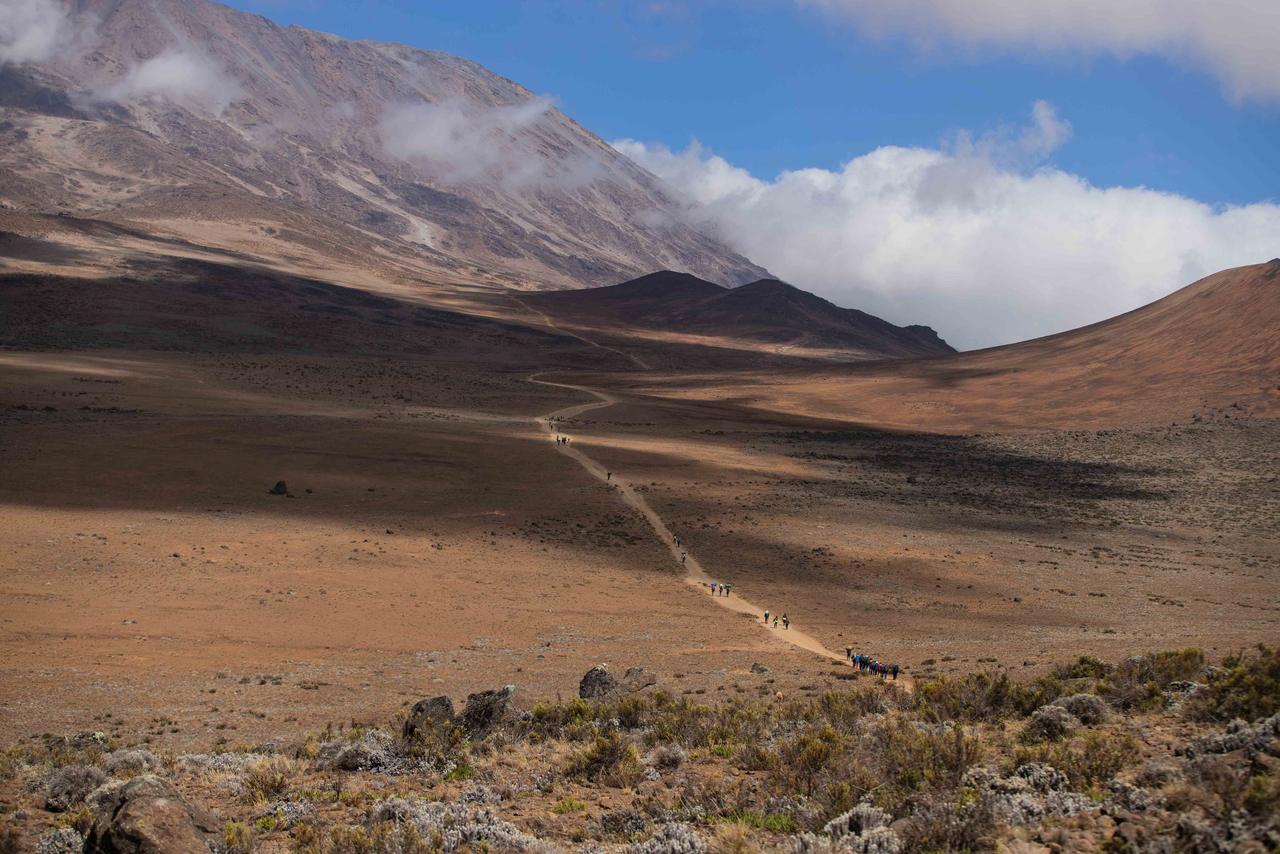
Kilimanjaro training plan: Train for summit day
Give yourself sixteen weeks if you are starting from scratch, twelve if you already exercise and eight if you already hike. Build one long weekend hike up to 8 h with 1,200 m of climbing and a pack of 8 kg, add short cardio and strength sessions on weekdays, and ease off in the last two weeks.
What you train for: The mountain sets the targets
Every number in the plan comes from the climb itself: summit day, the days before it, the pack you carry and the long way down. Only the thin air can’t be trained for at home.
Summit day
+1,222 m · −2,795 m
Up from a high camp at 4,673–4,800 m from around midnight, then down again: 15–17 h, breaks included.
In the plan:The two biggest weekends, at four and three weeks to go: up to 8 h with 1,200 m of climbing, and one start before dawn with a headlamp.
The days before
3–8 h a day
Walking every day, 6–9 days in a row, at a slow and steady pace.
In the plan:Back-to-back weekends from eight weeks out: a long hike, then another the next day on tired legs.
Your daypack
7–9 kg
Water (3 L), warm layers, rain gear and snacks. Porters carry the rest of your kit.
In the plan:From no pack to 8 kg, about a kilo at a time, in the pack you will take.
The way down
−4,035–4,255 m
From the summit down to the gate, over summit day and the next morning.
In the plan:Descents in every long hike and slow step-downs from eight weeks out, with poles.
The thin air
49%
Of sea-level air pressure at Uhuru Peak: about half the oxygen in every breath.
In the plan:No plan at home changes this. Time does: more days on the mountain and a slow pace.
The plan: Sixteen weeks, counted down
Every week has one long hike, two or three short cardio sessions and one or two strength sessions; from eight weeks out the long hike becomes a weekend of two. Pick where you start, then follow the plan to the day you fly.
Every week gets its dates, counted back from your flight. The calendar file has one entry per week from your start.
- Long hike
- Day after
- Cardio
- Strength
weeks to go
| Week | Long hike | Day after | On weekdays | Focus |
|---|---|---|---|---|
| BaseGet moving: short regular sessions and a weekly walk that grows. | ||||
| 16 weeks to goStart here | 1.5 h+150 mno pack | — | 2 × 30 min cardio2 × 20 min strength | Walk at a pace where you can still talk, but not sing. |
| 15 weeks to go | 2 h+200 m3 kg pack | — | 2 × 30 min cardio2 × 20 min strength | Wear the boots you will climb in, so they are broken in long before you fly. |
| 14 weeks to go | 2.5 h+300 m3 kg pack | — | 2 × 35 min cardio2 × 20 min strength | Find a slow, steady pace uphill that you could keep for hours. |
| 13 weeks to goLighter week | 2 h+200 m3 kg pack | — | 2 × 30 min cardio1 × 20 min strength | A lighter week: your body adapts while the load drops. |
| BuildHills and a pack: the long hike gets longer and steeper. | ||||
| 12 weeks to goStart here | 3 h+400 m4 kg pack | — | 3 × 35 min cardio2 × 25 min strength | Choose hilly routes, and do one weekday session on stairs or an incline. |
| 11 weeks to go | 3.5 h+500 m5 kg pack | — | 3 × 40 min cardio2 × 25 min strength | Carry a pack on every long hike from now on. |
| 10 weeks to go | 4 h+600 m5 kg pack | — | 3 × 40 min cardio2 × 25 min strength | Practise eating and drinking on the move: summit day burns about 5,000 kcal. |
| 9 weeks to goLighter week | 3 h+400 m5 kg pack | — | 2 × 35 min cardio1 × 25 min strength | A lighter week: your body adapts while the load drops. |
| MountainBack-to-back weekends, descents and your full kit. | ||||
| 8 weeks to goStart here | 5 h+700 m6 kg pack | 2 h+200 m | 2 × 45 min cardio2 × 30 min strength | The first back-to-back weekend: a second, shorter hike on tired legs. |
| 7 weeks to go | 5.5 h+800 m7 kg pack | 3 h+300 m | 2 × 45 min cardio2 × 30 min strength | Walk every descent with care, and add slow step-downs to your strength sessions. |
| 6 weeks to go | 6 h+900 m7 kg pack | 4 h+500 m | 2 × 50 min cardio2 × 30 min strength | Train in the clothes, layers and poles you will take, with 3 L of water. |
| 5 weeks to goLighter week | 4 h+600 m7 kg pack | — | 2 × 40 min cardio1 × 30 min strength | A lighter week: your body adapts while the load drops. |
| PeakThe two biggest weekends, as close to the mountain as training gets. | ||||
| 4 weeks to go | 7 h+1,000 m8 kg pack | 5 h+600 m | 2 × 50 min cardio2 × 30 min strength | The first big weekend: seven hours, then five the next day. |
| 3 weeks to go | 8 h+1,200 m8 kg pack | 6 h+700 m | 2 × 45 min cardio1 × 30 min strength | Dress rehearsal: start before dawn with a headlamp and your full summit kit. |
| TaperAbout half the training, then an easy week, so you arrive rested. | ||||
| 2 weeks to go | 5 h+700 m7 kg pack | 2 h+200 m | 2 × 40 min cardio1 × 20 min strength | About half the training, in the same rhythm. Keep a few climbs and descents. |
| The week you fly | 2 h+200 mno pack | — | 2 × 30 min cardio | Short, easy walks only. The first days on the mountain are slow: arrive rested. |
Hours are hours on your feet; the climb is the height gained on the hike, and most hikes come back down as far. Treat the times as a guide: walk at a pace you could keep all day, whatever the clock says.
A week in the plan: A long weekend, short weekdays
This is the week at 6 weeks to go. The weekend does most of the work; the weekday sessions are short enough to fit around a job.
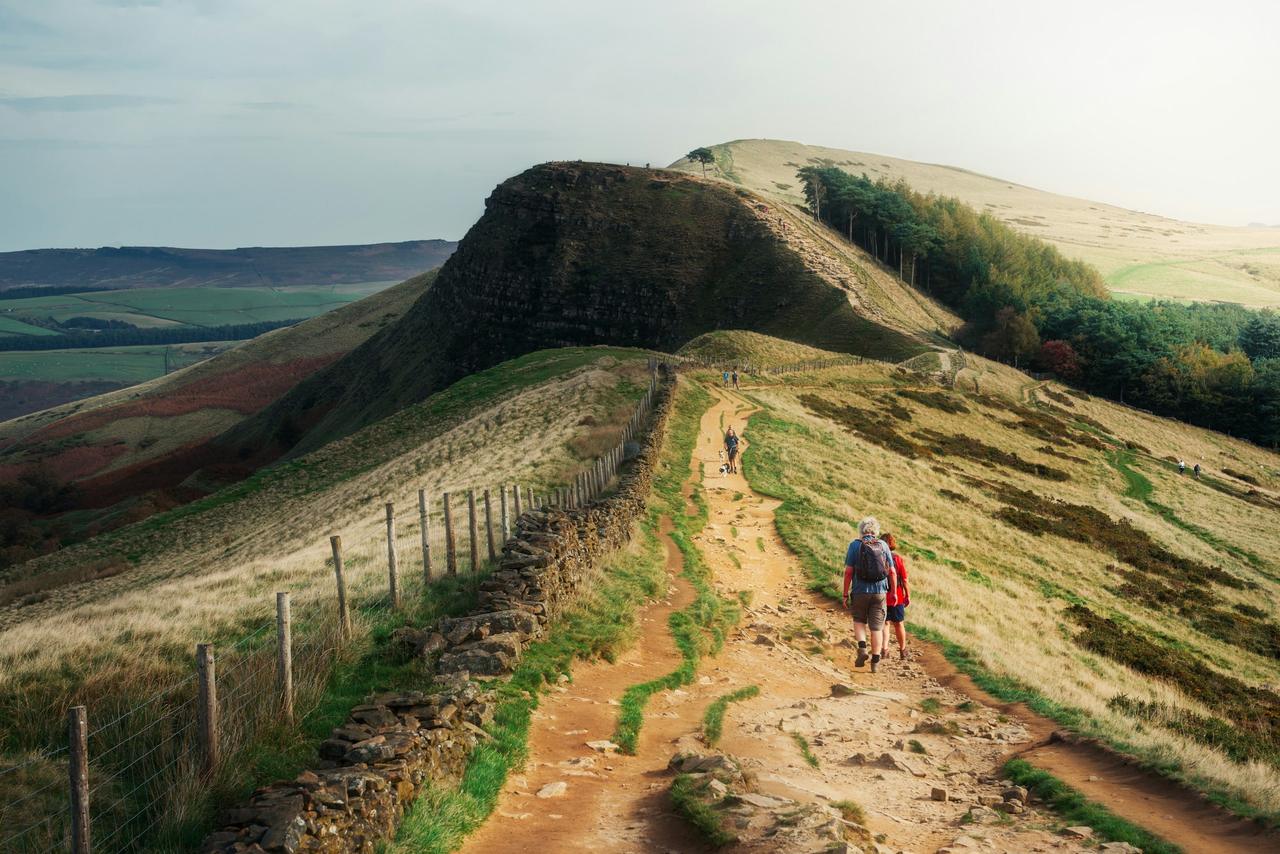
Photo: Ian Cylkowski / Unsplash
Mon
Rest
Tue
Cardio
50 min
Strength
30 min
Wed
Cardio
50 min
Thu
Strength
30 min
Fri
Rest
Sat
Long hike
6 h · +900 m · 7 kg
Sun
Hike, day two
4 h · +500 m
Move the days to fit your week, but keep a rest day before the long hike.
The long hike
The key session: hours on your feet, metres up and down, and the pack you will carry. Walk it at mountain pace, slow enough to keep going all day.
Cardio
Steady and moderate: you can talk, but not sing. Uphill walking, stairs, an inclined treadmill or a bike, once a week with your pack.
Strength
Six exercises for your legs and trunk, 20 to 30 minutes. They make the climbs, and the long descent, easier on your knees.
Rest
Your body gets stronger while it recovers. Keep at least one full rest day a week, and take another when your legs still ache.
Strength: Six exercises, twice a week
Climbing works your thighs and hips; the long descent loads the same muscles while they brake under your weight. These six need only a step, a wall and your pack.
Make it harder as the weeks go by
- Wear your pack for the step-ups and split squats, then add weight to the pack.
- Slow down: take three seconds on every way down.
- Add a third set before you add more weight.
- Stop a set when your form slips. Sore knees are a reason to go lighter.
Step-ups
3 × 10–12
Step up onto a sturdy step or bench about knee height, stand tall, step down. Change legs.
The climb: every step up the mountain.
Slow step-downs
3 × 8–10
Stand on one leg on a step and lower the other heel to the floor over three seconds, then step back up.
The descent: the braking your knees rely on.
Split squats
3 × 8–10
One foot forward, one back. Lower your back knee towards the floor and push up through the front heel.
Steep steps, and the scree on summit night.
Calf raises
2 × 15
On the edge of a step, rise onto your toes, then lower your heels slowly below the step.
Ankles and calves on uneven ground.
Hip bridges
2 × 12
Lie on your back with your knees bent and lift your hips until your body and thighs are in line. Hold for a second.
Hips and lower back, hour after hour under a pack.
Plank and side plank
2 × 30–45 s
On your forearms, body straight. Hold, then turn onto each side.
A steady trunk on rough trails.
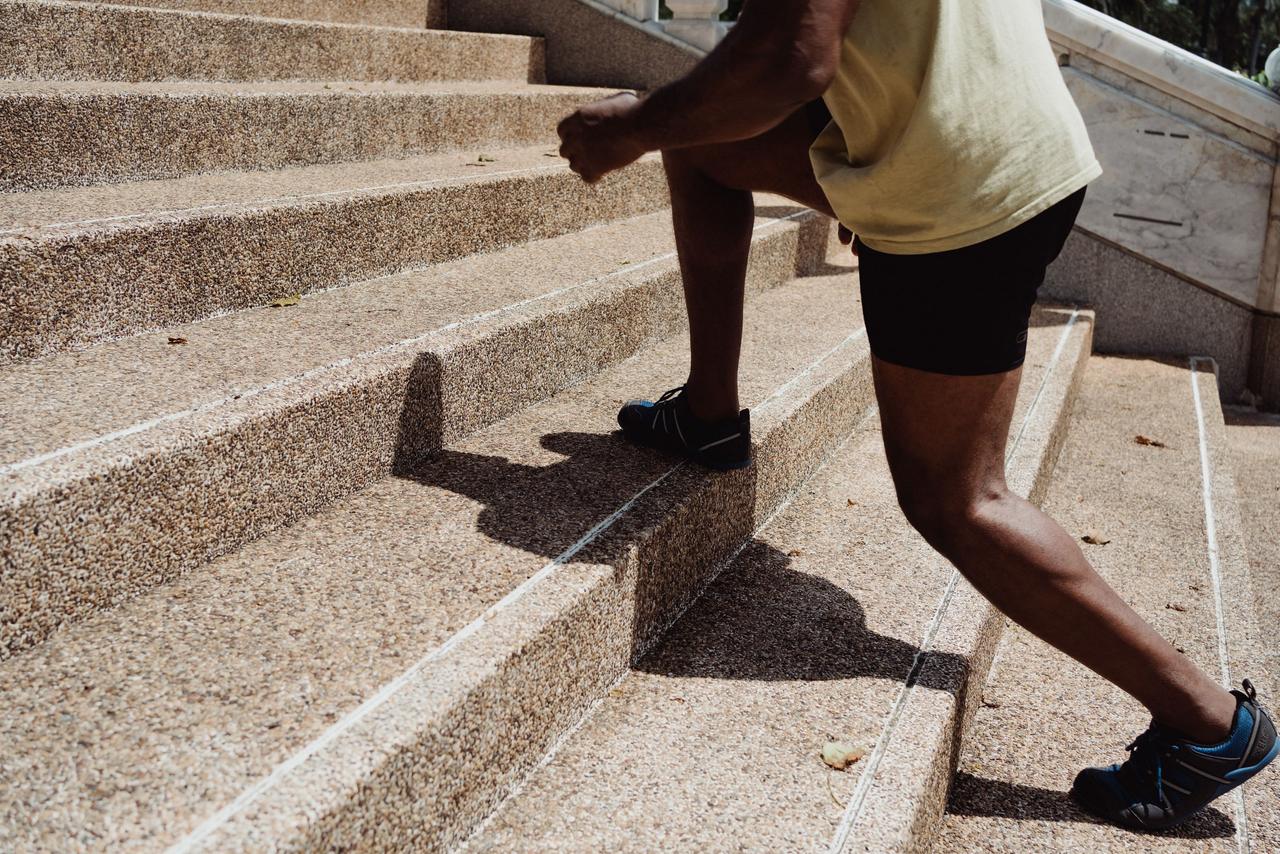
Photo: Ketut Subiyanto / Pexels
No hills nearby?: Stairs, a treadmill and a few weekends away
You can train the climb anywhere with stairs or a treadmill: summit night from Barafu is about 7,200 steps’ worth. For the back-to-back weekends, plan a few trips to real hills; stairs and treadmills build fitness, but not your footing on rough ground.
| Climb | Stair steps | Storeys | Treadmill |
|---|---|---|---|
| +300 m | 1,800 | 100 | 40 min |
| +600 m | 3,500 | 200 | 1 h 20 min |
| +1,000 m | 5,900 | 330 | 2 h 15 min |
| +1,200 m | 7,100 | 400 | 2 h 40 min |
Steps of 17 cm, storeys of 3 m; treadmill at 15% incline and 3 km/h, about 450 m an hour.
Stairs and stair machines
Climb with your pack, and walk down as well: the descent is half of what you are training. A stair machine only climbs, so add slow step-downs.
A treadmill on an incline
A steep treadmill climbs faster than most trails: even 3 km/h at 15% gains about 450 m an hour. Keep the talk-test pace, don’t hold the rails, and wear your boots and pack once a week.
Short hills, many times
Any long slope or tall flight of steps will do: dunes, bridges, a car park ramp. Twenty laps of 30 m make 600 m of climbing.
Weekends in the hills
Book two or three weekends in real hills for the back-to-back hikes at eight, six and four weeks to go: rough paths, long descents and a full day out.
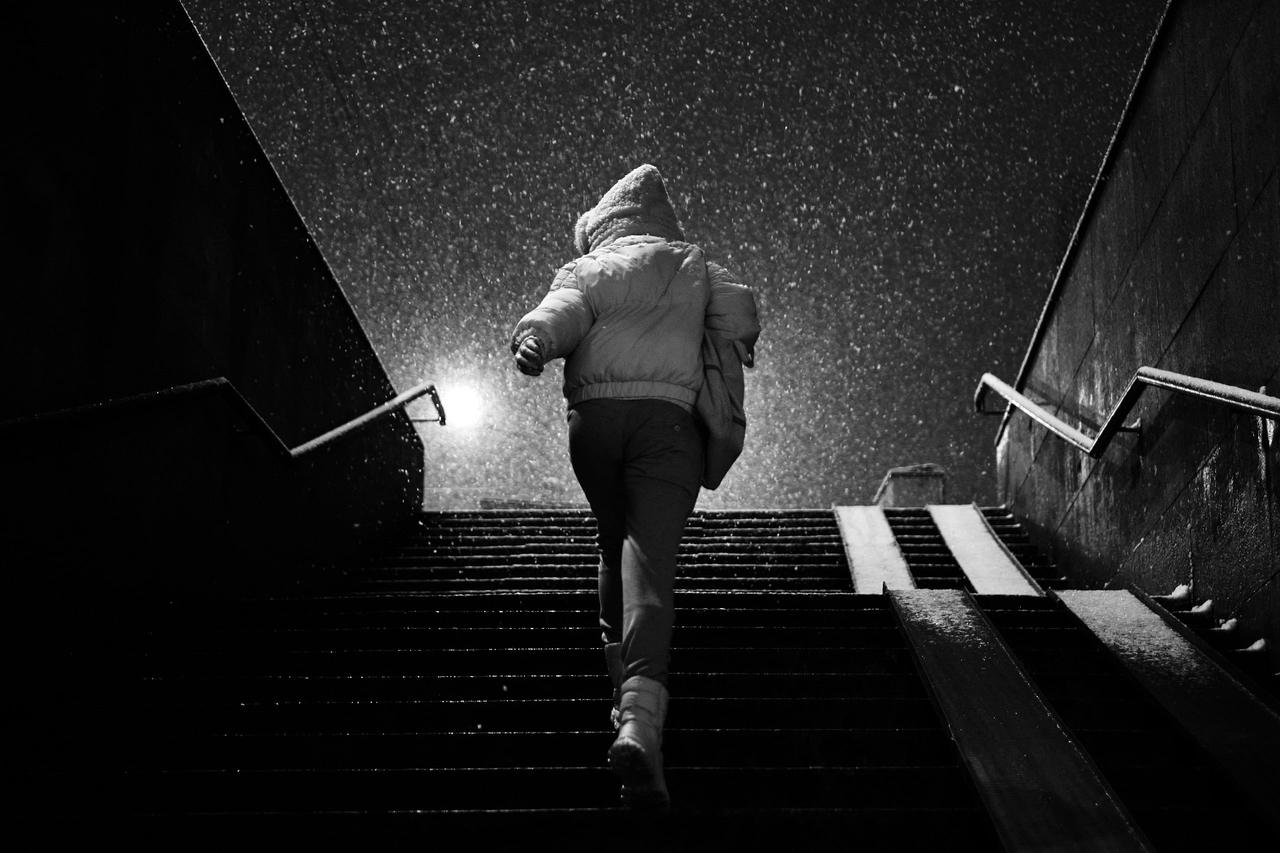
Photo: Stas Ostrikov / Unsplash
The way down: Train the descent, not just the climb
Summit day climbs about 1,222 m and then goes much further down, and the next day goes on down to the gate: 4,035–4,255 m in a day and a half. Legs that are not used to long descents can be sore for days.
From Barafu CampMachame · Lemosho · Umbwe · Shira
From Kibo HutMarangu · Rongai
From School HutNorthern Circuit
Start eight weeks out
One downhill session protected the legs for at least six weeks in one study, and five minutes of downhill walking a week earlier about halved the damage in another. Walk the descents of every long hike from eight weeks out, and keep some in the taper.
Step down slowly
Slow step-downs, and stairs walked down, train the muscles that brake every step. Take three seconds on each way down.
Use poles
Walking downhill with poles lowered the load on the knees by 12–25% in a lab study. Train with them, so they feel natural on the mountain.
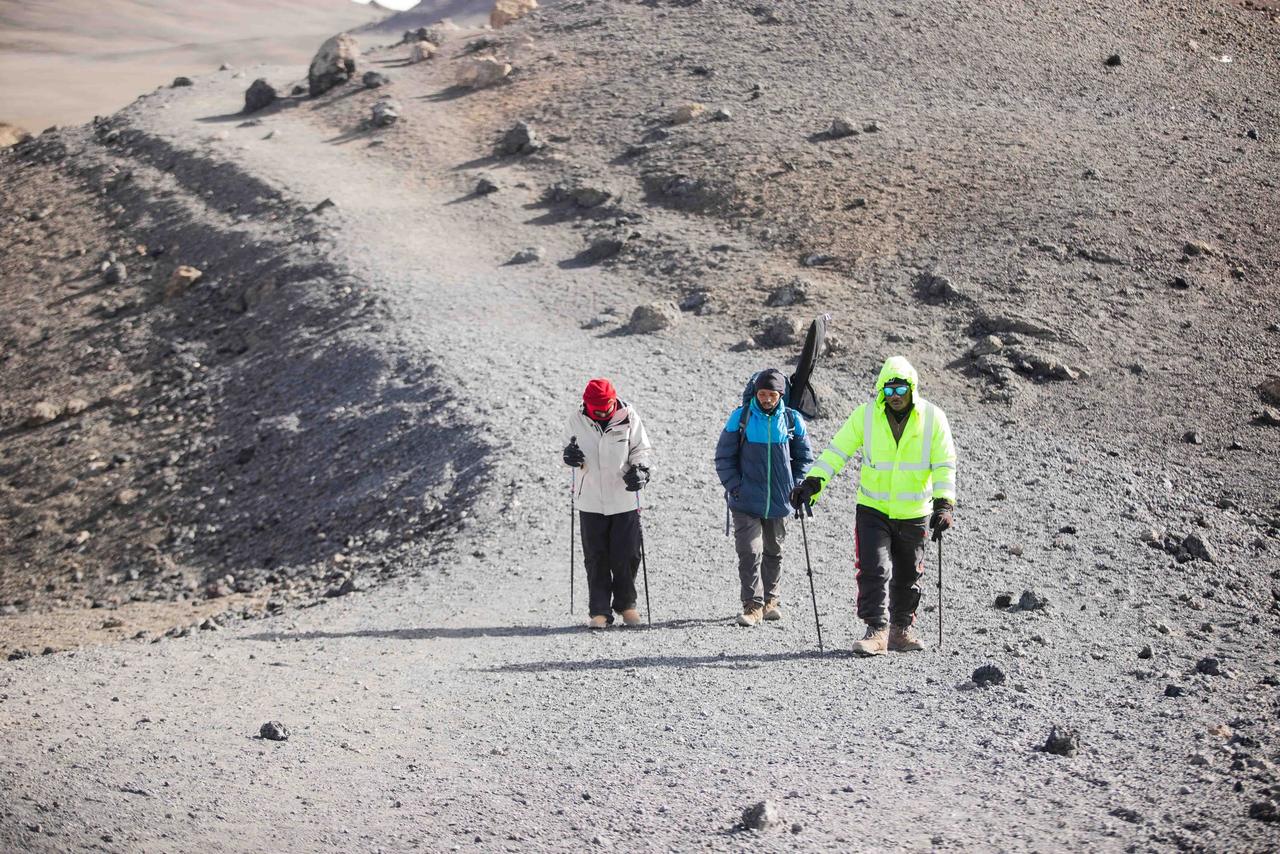
Photo: Penfran Tanzania / Pexels
Training and altitude: What training can do, and what it can’t
Training gets your legs, heart and lungs ready for long days. It can’t get your body used to the height: that takes days on the mountain.
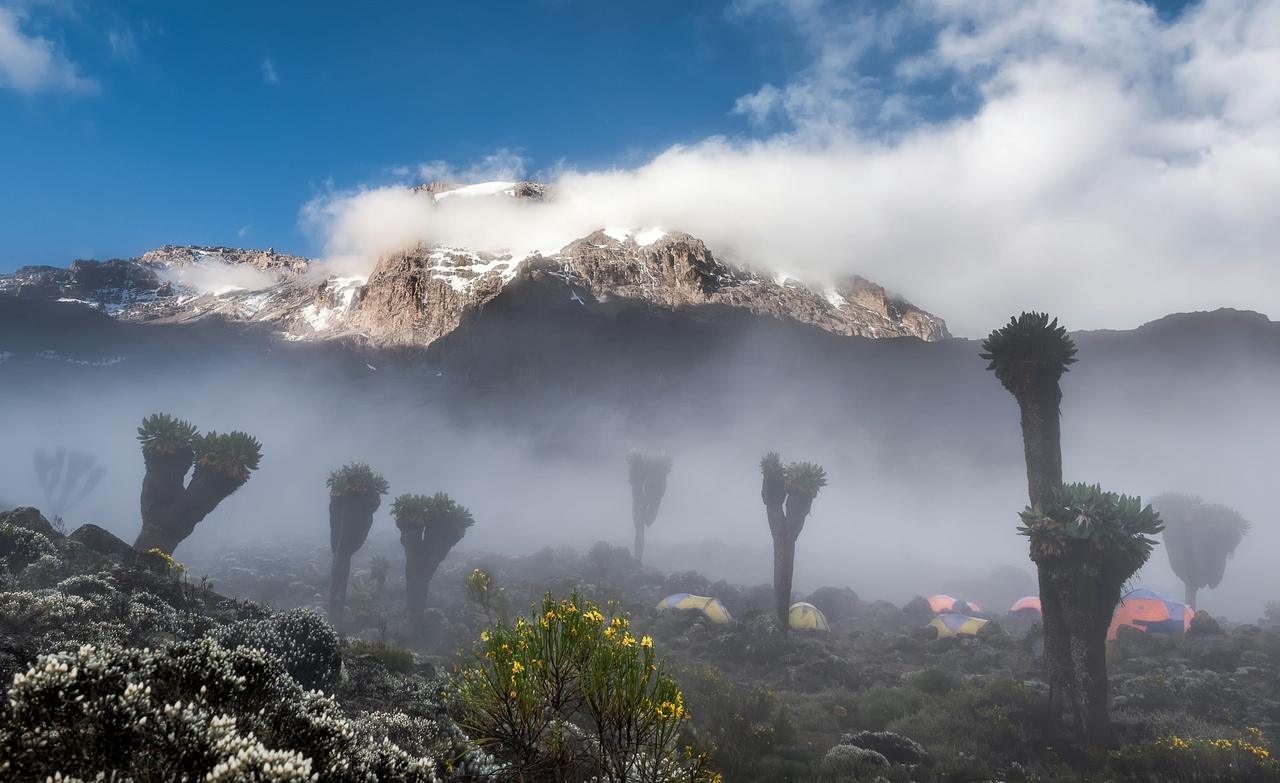
What training does
5,085 m
The days feel easier
A fitter body walks the same trail at a smaller share of what it can do. In a study of 44 trekkers going to 5,085 m in the Himalaya, the fitter ones rated the effort lower and chose a quicker step.
~55%
A reserve for summit day
Your aerobic capacity falls by about a tenth for every 1,000 m above 1,500 m, leaving roughly 55% of it at the top (an estimate). The same slow pace then takes a bigger share, and a fitter body has more to spare.
−4,035–4,255 m
Legs for the way down
Legs that have practised descents are damaged less by the next ones, so the long way down, and the days after it, hurt less.
What it doesn’t do
49%
It doesn’t prevent altitude sickness
“Training and physical fitness do not affect risk,” in the words of the CDC. In the same study of 44 trekkers, fitness made no difference to altitude sickness.
1,237
It didn’t decide who reached the top
In the largest study of Kilimanjaro climbers, 1,237 people, training (asked as a yes or no), self-rated fitness and earlier stays at altitude made no measurable difference to reaching Uhuru Peak.
×1.16
It doesn’t replace days on the mountain
In that study, each extra day on the mountain raised the odds of reaching the top by about 16%.
What does help with the height
More days on the mountain, a slow pace from the first morning, and turning back when symptoms grow. Altitude tents and masks are no substitute: the Wilderness Medical Society advises not to rely on tents. Talk to a doctor about altitude illness before you go.
Real life: When the plan meets your week
Few training weeks go to plan. These rules keep you on track without making up for lost time in a hurry.
Less time than you need?
Start at the week whose long hike you can already do, and follow the plan from there. Don’t skip ahead to catch up: a longer itinerary on the mountain helps more than a rushed plan.
Missed a week?
Repeat the last full week you did, then carry on. Missed two or more? Go back a step for each week you lost. Keep the taper: it is not the place to catch up.
Ill or injured?
Rest until you are well, then start again a step or two lower. Training through a fever or sharp pain costs more weeks than it saves. See a doctor or physiotherapist for an injury.
Older, heavier or new to exercise?
See your doctor before you start if you have heart, lung, kidney or metabolic disease such as diabetes, or get chest pain, unusual breathlessness or dizziness when you exert yourself. Give yourself the full sixteen weeks, and keep the pack light for longer.
No time for two days in a row?
Keep the long hike, and make the day after a shorter session on stairs or a treadmill. What counts is walking on tired legs.
The last days before you fly
No long hikes or hard sessions in the final week: walk a little, sleep and eat well. On the mountain, go slowly from the first morning, “pole pole” as the guides say.
Questions: What people ask about training for Kilimanjaro
How long should I train for Kilimanjaro?
About sixteen weeks if you rarely exercise, twelve if you exercise two or three times a week, and eight if you already hike regularly. All three end with the same weeks: back-to-back long hikes with your pack, then two easier weeks before you fly.
How fit do you need to be to climb Kilimanjaro?
Fit enough to walk 6–8 h on two days in a row with a 7–9 kg daypack, and to climb about 300 m an hour. Summit day takes 15–17 h, so being used to long days on your feet matters more than speed.
Can you climb Kilimanjaro without training?
Some people do, and in the largest study of Kilimanjaro climbers (1,237 people), training made no measurable difference to reaching the top; on Mount Whitney, a one-day climb, more weekly training went with slightly better odds. Without training the days of walking and the long descent are much harder, and there is less in reserve if you feel unwell. Even eight weeks of long walks help.
How many hours a week should I train?
From about 3 h a week at the start to about 16 h in the biggest weeks, most of it in the weekend hikes. The weekday sessions take 20 to 50 minutes each.
What is the best exercise to train for Kilimanjaro?
Walking uphill and downhill with a pack, for hours: in a review of training studies, programmes that included carrying a pack improved loaded walking the most. Hills, stairs, a stair machine or a treadmill on an incline all work. Running, cycling and swimming build stamina, but not the walking legs or the descent.
Should I train with a weighted backpack?
Yes. Build up from no pack to about 8 kg, the weight of your daypack on the mountain (7–9 kg with 3 L of water). Add weight slowly, about a kilo at a time, and only once the hike itself feels easy.
How do I train for Kilimanjaro if I live somewhere flat?
Use stairs, a stair machine or a treadmill: 1,000 m is about 5,900 stair steps, and a treadmill at 15% incline climbs about 450 m an hour at 3 km/h. Walk down as well as up. Plan two or three weekends in real hills for the back-to-back hikes.
Do I need to train at altitude or sleep in an altitude tent?
No. Training gets your legs ready, but not your body used to the height, and the Wilderness Medical Society advises not to rely on altitude tents; short sessions, masks included, are unlikely to help. Time at height does: more days on the mountain, or a few nights above 2,750 m in the two weeks before, which the CDC calls useful. Talk to a doctor about altitude illness before you go.
When should I stop training before the climb?
Cut your training by about half in the last two weeks, but keep the rhythm and a few climbs: studies of athletes found that works best. Do no long hikes in the final week. You want to arrive rested, not tired.
I’m over 50. Do I need a different plan?
The same plan works; give yourself the full sixteen weeks, an extra rest day when you need one, and some balance exercises. See a doctor first if you have a medical condition. In the study of 1,237 climbers those under 50 reached the top somewhat more often, and climbers aged 89 and over have reached Uhuru Peak.
How do I break in my hiking boots?
Wear them on every long hike from the start of the plan, with the socks you will climb in, so your feet get used to them and pressure points show up early. In a large survey of soldiers, boots that were not broken in went with about one and a half times as many blisters.
Sources
Updated
The plan follows the training guidance and the operators’ benchmarks below. Summit day, walking hours and heights are the published figures for each route. Health figures come from the studies and guidance listed; they are no substitute for a doctor’s advice.
- Studies
- Croughs et al. (2022), Journal of Travel Medicine 29(5): severe altitude illness and summit success among 1,237 Kilimanjaro hikers
- Rossetti et al. (2017), High Altitude Medicine & Biology: sea-level fitness, sense of effort and altitude sickness on a Himalayan trek
- Wagner et al. (2008), Medicine & Science in Sports & Exercise: summit success and altitude sickness on Mount Whitney
- Furian, Tannheimer & Burtscher (2022), Journal of Clinical Medicine: aerobic capacity at altitude (review)
- de Mol et al. (2011), Diabetes Care: energy use on Kilimanjaro (summit day about 5,000 kcal)
- Byrnes et al. (1985), Journal of Applied Physiology: one downhill session protects the legs for weeks
- Maeo et al. (2017), PLoS One: five minutes of downhill walking protects against later muscle damage
- Schwameder et al. (1999), Journal of Sports Sciences: knee loading when walking downhill with poles
- Knapik et al. (2012), Journal of Strength and Conditioning Research: training for load carriage (review)
- Bosquet et al. (2007), Medicine & Science in Sports & Exercise: tapering before an event (meta-analysis)
- Brennan et al. (2012), Military Medicine: boots not broken in and foot blisters
- Health guidance
- CDC Yellow Book: high-altitude travel and altitude illness
- Wilderness Medical Society: clinical practice guidelines for acute altitude illness (2024 update)
- NHS: altitude sickness
- American College of Sports Medicine: pre-participation health screening (2015), as reproduced by Whitfield et al. 2017
- Training guidance
- WHO guidelines on physical activity and sedentary behaviour (2020)
- CDC: measuring physical activity intensity (the talk test)
- German Alpine Club (DAV): planning a mountain walk (300 m an hour up)
- UK Building Regulations, Approved Document K: stair rise