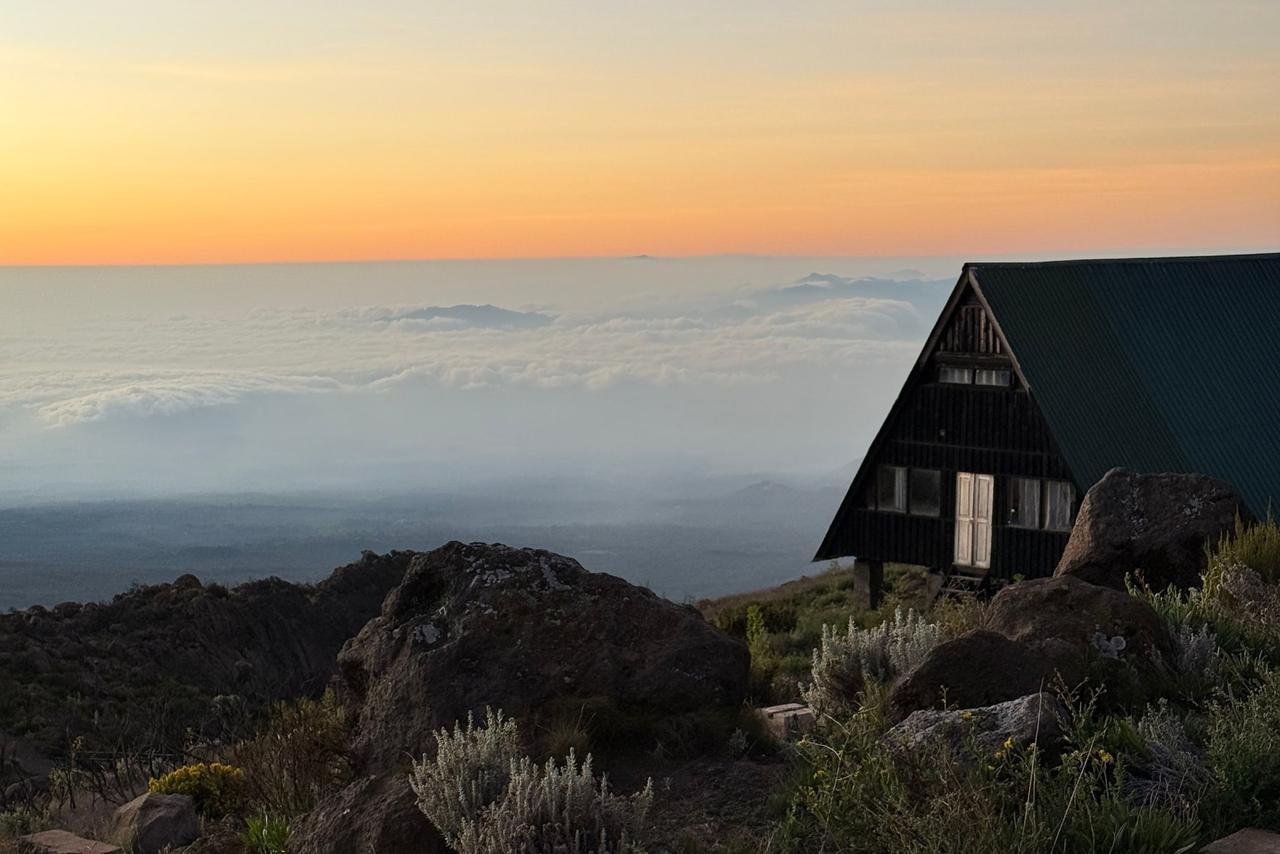
An A-frame hut of the Horombo Huts at sunset, above a sea of cloud

Kilimanjaro’s history: From the Chagga kingdoms to Uhuru

People farmed Kilimanjaro’s slopes for centuries before a European saw its snow in 1848. Hans Meyer and Ludwig Purtscheller reached the top in 1889; in 1961 the torch of Tanganyika’s independence was lit on the summit, and today more than 69,000 people a year set out to climb it.

History: From the Chagga kingdoms to Uhuru

People farmed Kilimanjaro’s slopes long before anyone stood on top. The mountain became known in Europe in 1848, was first climbed in 1889, was fought over by colonial powers, and in 1961 carried the torch of Tanganyika’s independence.

  1. Before 1848

    The people of the mountain

    1. Centuries ago

      Farmers settle the well-watered southern and eastern slopes. The Chagga grow bananas in layered home gardens and lead water to them from the forest in hand-dug furrows, some of them centuries old.

    2. 1500s–1800s

      Caravans from the Swahili coast pass the mountain on the ivory and slave routes inland, with Taveta at its eastern foot as their resting place. A Spanish geography of 1519 mentions a very high “Ethiopian Olympus” west of Mombasa, perhaps the first written hint of Kilimanjaro.

    3. 1800s

      The Chagga live in dozens of small kingdoms, each ruled by a mangi, often at war with one another. Maasai herders graze the plains below.

  2. 1848–1888

    Snow on the equator

    1. 11 May 1848

      The German missionary Johannes Rebmann, guided by the caravan leader Bana Kheri, sees something white on the summit. His guide supposes it is “coldness”; Rebmann recognises snow. In London the geographer William Cooley mocks the idea of snow so close to the equator.

    2. 1861–62

      Baron Karl Klaus von der Decken explores the mountain twice, with Richard Thornton and then Otto Kersten, and reaches about 4,300 m. Fresh snow falls on his camp, and the doubts about the snow fade.

    3. 1871

      On 28 August the missionary Charles New reaches the snow line, the first European to do so, and eats a handful of it.

    4. 1885–86

      German agents sign treaties with Chagga rulers, and Britain and Germany split East Africa between them, with Kilimanjaro on the German side.Snow on the equator

    5. 1887–88

      Hans Meyer tries twice. In 1887 he turns back at a wall of ice; in 1888 he is taken hostage during the Abushiri rising near the coast and has to be ransomed.

  3. 1889–1960

    The first ascent and the colonial years

    1. 6 Oct 1889

      Hans Meyer and Ludwig Purtscheller reach the summit and name it Kaiser-Wilhelm-Spitze. Two weeks later they walk on the floor of the crater.The first ascent and the colonial years

    2. 1891–1900

      Germany conquers the Chagga kingdoms. On 2 March 1900 colonial troops hang 19 Chagga, Meru and Arusha leaders at Old Moshi, among them Mangi Meli of Moshi.

    3. 1912

      Eduard Oehler and Fritz Klute make the first ascent of Mawenzi. Walter Furtwängler and Siegfried König make the first ski descent from Kibo.

    4. 1916

      In the First World War, British and South African troops fight German forces at the foot of the mountain and take Moshi. Tanganyika becomes a British mandate after the war.

    5. 1921

      The forest belt becomes a forest reserve. The surveyor Clement Gillman reaches the crater rim at the point now named after him.

    6. 1925–33

      Climbers find a frozen leopard on the crater rim; in 1927 Sheila MacDonald becomes the first woman on the summit; in 1933 the first steam vents are reported in the crater.

    7. 1952

      A British survey measures the summit at 5,895 m, the height still used today.

  4. 1961–2000

    Independence and the national park

    1. 9 Dec 1961

      On Tanganyika’s independence day, Lieutenant Alexander Nyirenda lights the Uhuru Torch on the summit and raises the new flag. In 1959 Julius Nyerere had promised a candle on top of Kilimanjaro that would shine beyond the borders. In the years after independence Kaiser-Wilhelm-Spitze is renamed Uhuru Peak, “freedom peak”.

    2. 1973

      Kilimanjaro National Park is created on 16 March. It opens to visitors in 1977, the year rangers mark out the Machame route.

    3. 1987

      UNESCO lists the national park as a World Heritage Site.

    4. 1996

      Yohani Kinyala Lauwo of Marangu, honoured at the 1989 centenary as a guide of the first ascent, dies after guiding on the mountain for decades.

  5. 2000–today

    A mountain for everyone

    1. 2005

      The park takes in the forest belt and more than doubles, to about 1,700 km².

    2. 2006

      A rockfall on the Western Breach kills three climbers on 4 January.

    3. 2020–22

      Two large fires burn about 100 km² of heath and bush on the upper slopes.

    4. 2021

      Measurements show 0.98 km² of ice left on the summit.

    5. 2024/25

      More than 69,000 climbers set out for the summit in one year.

    6. 24 Dec 2025

      A rescue helicopter crashes near Barafu Camp, killing five people.

The first ascent, and the guide

On 6 October 1889, Ludwig Purtscheller’s 40th birthday, he and the German geographer Hans Meyer stood on the highest point of Kibo’s rim. It was Meyer’s third attempt in three years. Their porters were led by Mwini Amani from Pangani on the coast, and Mangi Mareale of Marangu sent food up to their camps every third day. Above the last camp the two Europeans climbed alone, cutting steps for hours: in 1889 the ice still reached the crater rim.

Meyer named the summit Kaiser-Wilhelm-Spitze, planted a small German flag and took the topmost stone home for the Kaiser’s desk. His book names no Chagga guide on the climb. A century later, at the 1989 centenary, Yohani Kinyala Lauwo of Marangu was honoured as a guide of the expedition; by then he was very old, and his memories could not be matched with Meyer’s account. He guided on the mountain for decades and died in 1996.
Why Kilimanjaro is in Tanzania

In 1886 Britain and Germany agreed where their spheres in East Africa would meet. From the coast the line runs straight to Lake Jipe, then bends around the northern foot of Kilimanjaro before carrying on to Lake Victoria.

The bend follows the treaties. German agents had signed agreements with Chagga rulers at Moshi in 1885, while British interests lay at Taveta, so the line passes between the two. Britain kept Mombasa and Germany got the mountain. At independence the same line became the border between Kenya and Tanzania.

The popular story that Queen Victoria gave Kilimanjaro to her grandson, the Kaiser, as a birthday present has no basis: Wilhelm II only came to the throne in 1888.

Highlight climbs: Firsts, records and remarkable people

Since 1889 the mountain has seen ski descents, ice climbs, record runs and climbers of every age and ability. A selection, with the records as they stand in October 2026.

  1. 1889First

    The first ascent

    Hans Meyer and Ludwig Purtscheller reach the top on 6 October, Purtscheller’s 40th birthday.The first ascent

  2. 1912First

    Mawenzi, and skis on Kibo

    Eduard Oehler and Fritz Klute climb Mawenzi’s Hans Meyer Peak, 23 years after Kibo. The same year Walter Furtwängler skis down from Kibo.

  3. 1927First

    The first woman on top

    Sheila MacDonald reaches the summit on 31 July. Other women had reached the crater rim before her, in 1914 and 1925.

  4. 1961People

    The Uhuru Torch

    Lieutenant Alexander Nyirenda carries the torch of independence to the summit on 9 December.

  5. 1978First

    The Breach Wall

    Reinhold Messner and Konrad Renzler climb a pillar of ice high on Kibo’s south-west face. The icicle that made the route possible rarely forms any more.

  6. 1997People

    Blind on the summit

    Erik Weihenmayer reaches Uhuru Peak on 11 August, on his way to becoming the first blind climber of the Seven Summits.

  7. 2009People

    Nine celebrities

    Gary Barlow, Cheryl Cole and seven others reach the top for Comic Relief and raise millions of pounds.

  8. 2012People

    On his hands

    Spencer West, who lost both legs as a child, climbs most of the way on his hands.

  9. 2014 · 2017Curiosity

    Sport in the crater

    The highest cricket match ever played, at 5,752 m in 2014, and the highest football match, at 5,714 m in 2017, both in Kibo’s crater.

  10. 2019Record

    Oldest on top

    Anne Lorimor reaches the summit aged 89, the oldest person to do so. A 90-year-old reported reaching the top in July 2026; the record is not yet confirmed.

  11. 2023Record

    Fastest ever

    Tyler Andrews runs from Mweka Gate to the top in 4 h 32 min and back down in 6 h 38 min in total, carrying all his own food and water. The record before his was Karl Egloff’s, and before that Kilian Jornet’s.

  12. 2026Record

    Fastest woman

    Erin Ton runs up in 5 h 48 min and back in 8 h 34 min. A month later Kelly Halpin sets the first women’s time without outside help.

The records, checked October 2026

RecordWhoTime or ageWhen
Fastest up and downTyler Andrews (USA)6:37:5713 Mar 2023
Fastest upTyler Andrews (USA)4:32:4013 Mar 2023
Fastest woman, up and downErin Ton (USA)8:33:426 Sep 2026
Oldest personAnne Lorimor (USA)89 years18 Jul 2019
Oldest manFred Distelhorst (USA)88 years20 Jul 2017

There is no official record for the youngest climber: the park’s minimum age for the summit is 10, and younger children have only gone up with special permission.

Questions: The history, answered

Who first climbed Kilimanjaro?

The German geographer Hans Meyer and the Austrian mountaineer Ludwig Purtscheller, on 6 October 1889. Yohani Kinyala Lauwo of Marangu was honoured as a guide of their expedition at its centenary in 1989. The Chagga had gone high on the mountain long before, but no earlier ascent of the summit is recorded.

Why is Kilimanjaro in Tanzania and not in Kenya?

Because of an Anglo-German agreement of 1886. Germany had signed treaties with Chagga rulers at Moshi, Britain had interests at Taveta, and the line between their spheres was drawn around the mountain’s northern foot. That line later became the border between Kenya and Tanzania. The story that Queen Victoria gave the mountain to the Kaiser is a myth.

Did Kilimanjaro belong to Germany?

Yes, for about 30 years. It lay in German East Africa from the 1880s until British and South African troops took the area in 1916; after the First World War Tanganyika came under British rule, and it became independent in 1961. In the German years Hans Meyer’s Kaiser-Wilhelm-Spitze was called the highest mountain of the German Empire; it is now Uhuru Peak.

Why is the summit called Uhuru Peak?

Uhuru is Swahili for freedom. On Tanganyika’s independence day, 9 December 1961, a torch was lit on the summit, and in the years that followed the peak Hans Meyer had named Kaiser-Wilhelm-Spitze was renamed Uhuru Peak.

Who was the first woman to climb Kilimanjaro?

Sheila MacDonald, on 31 July 1927. Other women had reached the crater rim before her: Clara von Ruckteschell-Trüeb in 1914, at today’s Gilman’s Point, and Stella Latham in 1925, at the point named after her.

What is the fastest climb of Kilimanjaro?

Tyler Andrews ran from Mweka Gate to the summit in 4 h 32 min and back in 6 h 37 min 57 s on 13 March 2023, carrying all his own food and water. Before him, Kilian Jornet (7 h 14 min, 2010) and Karl Egloff (6 h 42 min, 2014) held the record. The fastest woman is Erin Ton: 8 h 33 min 42 s up and down, on 6 September 2026.

Who is the oldest person to have climbed Kilimanjaro?

Anne Lorimor of the United States, who reached Uhuru Peak on 18 July 2019 aged 89 years and 37 days. The oldest man is Fred Distelhorst, aged 88, in 2017. A 90-year-old reported reaching the top in July 2026; that record is not yet confirmed.