Kilimanjaro FAQ: Your questions, answered
Straight answers to the 69 questions people ask most before they climb Kilimanjaro: guides and permits, days and routes, fitness, altitude and safety, visas and vaccines, toilets, summit night and the mountain itself.
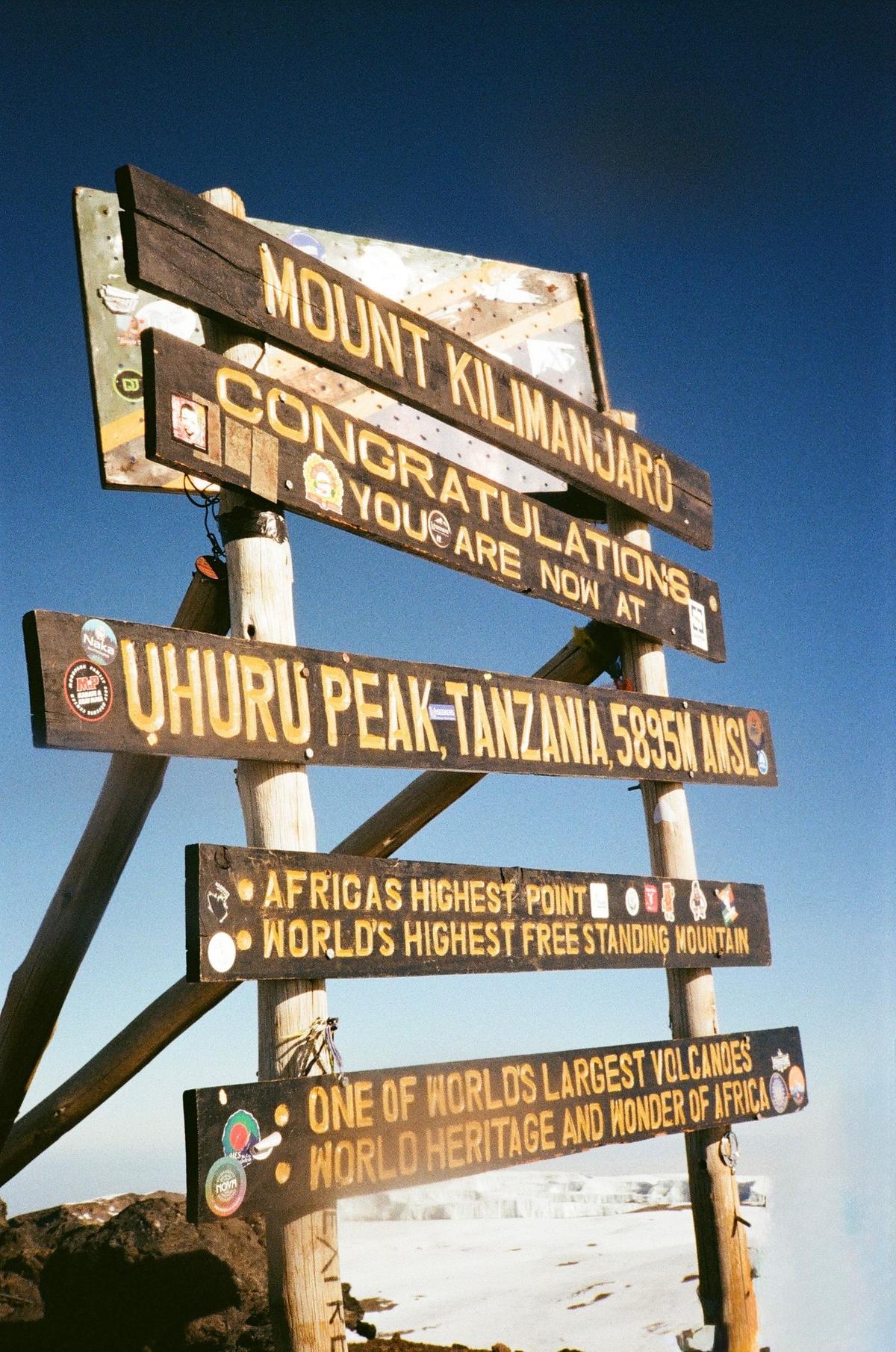
Photo: Marina Zvada / Pexels
The short answers: What everyone asks first
Eight answers in a word or a number. Each one opens the full answer below.
- Can I do it in a day?NoFive days at the very least; most climbers take seven or eight.
- Do I need a guide?YesEvery climber goes with a licensed guide: it is the park’s rule.
- Climbing experience?NoneIt is a trek: no ropes, no crampons, no harness.
- How many days?6–9Seven or eight give your body time to adjust.
- What does it cost?$2,200–$3,500Per person, park fees included, before flights and tips.
- When should I go?Jan–Feb, Jun–OctThe two dry seasons; the first often runs into early March.
- Bottled oxygen?NoCrews carry it for emergencies only.
- How high is it?5,895 mUhuru Peak, the highest point in Africa (19,341 ft).
Planning, guides and booking
Is climbing Kilimanjaro worth it?
For most people who go, yes, but know what you sign up for: a week of walking, simple camps, cold nights, one very long summit night and a bill of several thousand dollars. In return you cross five climate zones, from rainforest to glaciers, and stand on the roof of Africa without any climbing skills. Take enough days: they make the difference between a hard trip and a miserable one.
Read more: How hard is it?Can you climb Kilimanjaro without a guide?
No. The park’s rules require a licensed guide for every climbing group, booked through a licensed tour operator, and solo trekking is not permitted: you sign the park’s register at the gate and at the ranger post of every camp. The guide comes with a crew of cooks and porters, so even a climb on your own is a team effort.
Read more: TippingCan I climb Kilimanjaro on my own?
Yes, with your own guide and crew: most operators run private climbs for one person, at about a quarter more than each of two climbers pays. To share the cost and meet other climbers, join a scheduled group departure. Many women climb solo with reputable operators; ask for a female guide if you would like one.
Read more: Cost & park feesCan I climb without porters?
Hardly anyone does. The park requires a guide, not porters, and a few operators run lean climbs where you carry your own pack. But someone still has to carry the tents, food, water and fuel for a week. Portering is one of the main jobs around the mountain, so the fair choice is a crew that is paid and treated well.
Read more: TippingDo you need a permit to climb Kilimanjaro?
Yes, and your operator arranges it: there is no separate permit to apply for. The park fees for your climb (a daily conservation fee, camping or hut fees and a rescue fee) are your permit, paid through the licensed operator that books your guide and checked when you register at the gate. Nobody climbs for free.
Read more: Cost & park feesHow do I choose a tour operator?
Look past the price. Ask how many guides and porters come per climber, what the porters earn and whether the company is a partner of KPAP, the porters’ welfare project; whether guides check your oxygen level twice a day and carry emergency oxygen; and what the price includes. Very cheap quotes usually mean an underpaid crew or corners cut on safety.
Read more: TippingHow much does it cost to climb Kilimanjaro?
About $2,200–$3,500 per person with a reputable operator for seven or eight days, park fees included. The park fees alone come to about $1,128 for a seven-day climb. On top come flights, a visa, insurance, any gear you rent and the crew’s tips, about $330–$480 per climber when two of you climb together.
Read more: Cost & park feesWhat does the price of a climb include?
Usually the park fees, the guides, cook and porters, all meals and drinking water on the mountain, the tents and the transfers to and from the gate, often with a hotel night before and after. Usually not: flights, the visa, insurance, sleeping bag and gear rental, tips and drinks in town. Check each quote line by line before you compare prices.
Read more: Cost & park feesHow far ahead should I book?
Many climbers book three to six months ahead. For the busiest dates (July to September, January and February, and climbs over Christmas and New Year) book earlier, as group departures fill and flights rise. In the rainy months a few weeks can be enough. Leave time to train and to see a travel clinic.
Read more: Best time to climbCan I climb Kilimanjaro for charity?
Yes, and many people do, either on a charity’s own challenge trip or by booking a climb yourself and raising the money separately. Ask how much of what you raise goes to the charity and how much pays for the trip, and who runs the climb on the mountain: the same questions about days, guides, porters and safety apply.
Read more: Cost & park feesRoutes, days and when to go
Which route is best?
For most first-time climbers, Lemosho in eight days or Machame in seven: both are scenic and climb high, then sleep low. The Northern Circuit, in nine days, is the longest and has fewer groups; Marangu is the only route with huts; Rongai, from the north, is drier in the rains; Umbwe is the steepest.
Read more: Route finderHow many days does it take to climb Kilimanjaro?
Between six and nine days on the mountain, depending on the route and the plan: at least six, better seven or eight. Each extra day gives your body more time to adjust to the height and improves your chance of reaching the top. The park allows a five-day climb on Marangu, but few climbers adjust that fast.
Read more: RoutesHow far do you walk on Kilimanjaro?
About 53 to 88 km from gate to gate, depending on the route. Most days cover 5–15 km at a slow pace; summit day is the longest, up to the top and down to a lower camp. Distance matters less than height: the hard part is the climb into thin air, not the kilometres.
Read more: RoutesAre all the routes open?
Yes. In late September 2026 a wildfire on the slopes closed the Lemosho and Londorossi routes, and Rongai followed in early October; the park reopened all three on 8 October. The Western Breach, a steep way into the crater, has been closed since January 2024. Wildfires break out in many dry seasons, so check with your operator shortly before you travel.
Read more: RoutesCan you climb Kilimanjaro in one day?
No. The shortest climb the park allows is five days on the Marangu route, and most climbers take seven or eight. Mountain runners with special permission have run up and down in under seven hours, which is a record, not a plan. If you only have a day, a guided hike from Marangu Gate takes you through the rainforest to Mandara Hut, in a forest clearing, and up Maundi Crater for the view.
Read more: Camps & hutsHow many climbers reach the summit?
Most do, if they take enough days. The park publishes no figures. In the largest study on the mountain, 88% of 1,237 climbers reached Uhuru Peak and 92% at least the crater rim. Operators’ estimates per route run from about half on the shortest plans to nine in ten on eight- and nine-day ones.
Read more: Route finderWhen is the best time to climb Kilimanjaro?
In the two dry seasons: January to early March, and June to October. August and September are the driest, January and February a little warmer. April and May (the long rains) and November (the short rains) are the wettest, with far fewer climbers. The park is open, and climbs run, all year.
Read more: Best time to climbIs Kilimanjaro crowded?
On the southern routes in the dry season, yes. About 69,000 people climbed in 2024/25, about 40% of them on Machame, and most between June and October or December and February. Barranco and Barafu camps are shared by four routes. The Northern Circuit and Rongai see fewer groups until they meet the summit trails, and the rainy months far fewer climbers.
Read more: Camps & hutsCan you climb Kilimanjaro from Kenya?
Not from the Kenyan side: the mountain and every route’s gate are in Tanzania, though the summit is only about 20 km from the border. You can fly into Nairobi and take a shuttle bus over the Namanga border to Arusha or Moshi; coming in from Kenya, you need a yellow fever certificate. The Rongai route starts closest to Kenya, on the northern slopes.
Read more: RongaiFitness, age and experience
Do I need climbing experience?
No. Kilimanjaro is a trek, not a technical climb: no ropes, harness or crampons on the standard routes. The Barranco Wall, on four routes, is a short scramble where you use your hands for balance. What helps is being used to long walking days, several in a row.
Read more: How hard is it?How hard is it to climb Kilimanjaro?
Hard, but not technical. Most days are four to seven hours of walking at a slow pace. The altitude is the real test: at the summit each breath holds about 49% of the oxygen at sea level. Summit day is the hardest, about 15–17 h from a midnight start, in freezing cold.
Read more: How hard is it?How fit do you need to be?
Fit enough to walk six to eight hours on two days in a row with a daypack of 7–9 kg. You don’t need to be an athlete: ordinary, reasonably fit people reach the top every day. Fitness makes the walking easier, but it doesn’t protect you from altitude sickness, and fit climbers often walk too fast.
Read more: How hard is it?Can you climb Kilimanjaro without training?
Some people do, and in the largest study of Kilimanjaro climbers training made no measurable difference to reaching the top. Without it, though, the long days and the descent are much harder, and there is less in reserve if you feel unwell. Walk uphill and downhill with a pack: about sixteen weeks if you rarely exercise, eight if you already hike.
Read more: Training planIs there an age limit?
Only a lower one. Children under 10 may not climb above 3,700 m, so ten is the youngest age for a summit attempt. There is no upper limit: the oldest climber on record reached Uhuru Peak at 89. In the largest study, climbers under 50 reached the top somewhat more often, and every extra day on the mountain helped at any age. See a doctor first if you have a medical condition.
Read more: How hard is it?Can children climb Kilimanjaro?
From the age of 10, yes. Children feel the altitude as much as adults and are less likely to say so, so choose a long route that climbs slowly, such as Lemosho or the Northern Circuit, and an operator used to families. Younger children can walk the forest on a day hike, below 3,700 m.
Read more: Altitude sicknessCan I climb with asthma, diabetes or another condition?
Many people with a well-controlled condition reach the top, but see your doctor or a travel clinic before you book: cold, dry air, long days of exercise and thin air all affect asthma, diabetes and heart conditions, and a hospital is a day or more away. Carry your medicines in your daypack, enough for the whole trip, and tell your lead guide on the first day.
Read more: Altitude sicknessIs the Barranco Wall dangerous?
It looks steep from below, but it is a scramble, not a climb: a 257 m rock wall with a well-trodden path, where you use your hands for balance at a few spots and guides help at the narrow ones. It usually takes one to two hours. It is on the Machame, Lemosho, Shira and Umbwe routes.
Read more: How hard is it?Is Kilimanjaro harder than Everest Base Camp?
In most ways, yes: it is higher and faster. Uhuru Peak is about 530 m higher than Everest Base Camp, and Kilimanjaro’s routes reach the top on day 5–8, against about eight days of walking up to the base camp. Neither needs climbing skills, but no day on the base camp trek is as long as Kilimanjaro’s summit day.
Read more: How hard is it?Altitude, health and safety
Will I get altitude sickness on Kilimanjaro?
Most climbers feel it in some way: in the largest study, 63% had mild symptoms such as a headache or nausea, and 8.6% at least one severe one. A slow pace and more days are what lower the risk. Rest when you feel unwell, and go down at once if you are confused, stumble or are breathless at rest.
Read more: Altitude sicknessShould I take Diamox?
Ask a doctor or a travel clinic. Mountain-medicine guidelines say acetazolamide (Diamox), the usual altitude tablet, should be strongly considered on a climb as fast as Kilimanjaro: in trials it roughly halved the risk. It is prescription-only, often makes your fingers tingle and you pee more, and it never replaces a slow climb.
Read more: Altitude sicknessDo you need bottled oxygen to climb Kilimanjaro?
No. Climbers don’t use oxygen on Kilimanjaro: the body adjusts to the thin air if you climb slowly, even though each breath at the summit holds only about 49% of the oxygen at sea level. Good operators carry an oxygen cylinder and a pulse oximeter for emergencies, to help someone down. Ask yours.
Read more: Altitude sicknessIs climbing Kilimanjaro dangerous?
For most climbers it is a hard trek, not a dangerous one, but people do die on Kilimanjaro, most of them from altitude illness. The real risks are climbing too fast, ignoring symptoms, the cold, and falls on loose ground on summit night. A long plan, a slow pace, honest answers to your guide and turning back in time keep it safe.
Read more: Altitude sicknessHow many people die on Kilimanjaro?
The park publishes no count. Doctors at the hospital in Moshi examined 21 climbers who died in 2016 and 2017, and 19 of them had died of fluid on the lungs from the altitude (HAPE). An earlier study there counted about 13.6 deaths per 100,000 climbers in 1996–2003. Porters and guides die too, and are rarely counted.
Read more: Altitude sicknessWhat happens if I get sick on the mountain?
Your guides take you down, because going down is the treatment. A guide walks you to a lower camp, or rangers bring you down on one of the park’s wheeled stretchers to a vehicle track. In daylight and good weather a helicopter can land at camps up to about 4,600–4,900 m, paid by your insurer. From the gate you go to a hospital in Moshi.
Read more: Altitude sicknessWhat travel insurance do I need?
A policy that covers trekking to 6,000 m and helicopter evacuation: a rescue flight can cost $3,000–$10,000. Since October 1, 2026 every visitor to mainland Tanzania must also buy the government’s travel insurance ($44 per adult), but it says nothing of mountains or rescue and doesn’t replace your own. Carry the policy number and the emergency phone number.
Read more: Cost & park feesWhich vaccinations do I need?
A yellow fever certificate only if you come from a country with yellow fever, or change planes there for more than 12 hours: Kenya and Ethiopia count. Travel clinics usually advise hepatitis A, typhoid and tetanus, and being up to date on routine vaccines. See a travel clinic six to eight weeks before you fly.
Read more: Packing listIs there malaria on Kilimanjaro?
Not on the climb: there is no malaria above about 1,800 m, and every camp is higher. Moshi, Arusha, the safari parks and Zanzibar are malaria areas, though, so ask a travel clinic about tablets, use repellent in the evening and sleep under a net or in a screened room in town.
Read more: Packing listGetting there, visas and money
Do I need a visa for Tanzania?
Most visitors do. Apply online on the official e-visa site before you fly: a single-entry visa costs $50, and US citizens pay $100 for a multiple-entry visa. Many nationalities can still buy a visa on arrival, but the online one is recommended. Your passport must be valid for six months after arrival, with a blank page.
Read more: Packing listWhich airport do I fly into?
Kilimanjaro International Airport (JRO), between the two towns: about 30 km from Moshi and 40 km from Arusha. Airlines fly there from Amsterdam, Paris, Brussels, Zurich (in season), Doha, Dubai, Istanbul, Addis Ababa and Nairobi, and most operators pick you up. Other ways in are Dar es Salaam or Zanzibar with a domestic flight, or Nairobi with a shuttle bus over the border.
Read more: Cost & park feesWhen should I arrive in Tanzania?
A day or two before the climb starts. That gives you time to get over the flight, meet your guide for the briefing and the gear check, rent what you are missing, and lets a delayed bag catch up with you. Most operators include a hotel night before the climb; many climbers add a safari or a few days on the coast afterwards.
Read more: Packing listHow much cash should I bring?
Enough US dollars for the crew’s tips, which most climbers hand over in cash on the last day, plus a little for rentals and spending. Bring notes printed in 2013 or later, clean and untorn, many of them small. In town, pay in Tanzanian shillings: cash machines in Moshi and Arusha give shillings.
Read more: TippingCan I combine Kilimanjaro with a safari or Zanzibar?
Yes, and most climbers do: climb first, while you are fresh, then rest on a safari or a beach. The northern parks, such as Tarangire, the Ngorongoro Crater and the Serengeti, start a few hours from Arusha, and Zanzibar is about an hour’s flight from Kilimanjaro airport. The dry seasons suit all three.
Read more: Best time to climbShould I climb Mount Meru first?
Many climbers do, to adjust to the altitude. Mount Meru (4,562 m), near Arusha, takes three or four days, with an armed ranger walking with every group. Climbers who sleep high on Meru shortly before Kilimanjaro arrive partly adjusted to the altitude, and its knife-edge crater rim has views straight across to Kibo.
Read more: Altitude sicknessLife on the mountain
Where do you sleep on Kilimanjaro?
In tents on six routes, pitched by your crew at fixed campsites; two climbers share one. On the Marangu route you sleep in the park’s huts, on bunk beds with foam mattresses. Nights are cold: around freezing at 4,000 m and well below at the high camps, so a warm sleeping bag matters.
Read more: Camps & hutsAre there toilets on Kilimanjaro?
Yes. Every camp has the park’s toilets: wooden long-drop huts, and at many camps newer blocks with squat and sit-down cubicles. Mandara and Horombo huts have flush toilets. Many operators also bring a private toilet tent, which most climbers find well worth it. Between camps you go behind a rock and carry your paper out.
Read more: Camps & hutsCan you shower on Kilimanjaro?
Not on the camping routes. Your crew brings a bowl of warm water to your tent in the morning and evening, and wet wipes do the rest. A few high-end operators heat water for a shower tent. The lower Marangu huts have cold running water.
Read more: Camps & hutsWhat do you eat on the climb?
Three hot meals a day, cooked by your crew: porridge, eggs and toast in the morning, soup with a hot lunch or a packed one, and soup, then pasta, rice or stew with vegetables in the evening, with fruit, tea, coffee and snacks. Good cooks manage vegetarian, vegan, halal and gluten-free diets; tell your operator when you book.
Read more: Camps & hutsIs the water safe to drink?
Yes, once it is treated. Porters fetch water from streams near the camps, and the crew boils, filters or treats it before filling your bottles. Many climbers add their own purification tablets for peace of mind. Drink several litres a day, enough to keep peeing plenty.
Read more: Packing listIs there phone signal, and can I charge my phone?
Signal comes and goes, often only at one spot in camp, and Vodacom covers the most. The Marangu huts have Wi-Fi hotspots. There are no sockets at any camp, so bring a power bank and keep it warm in your sleeping bag at night, as the cold drains batteries fast.
Read more: Camps & hutsWhat if I have my period on the climb?
It is common and manageable. Bring enough products for the whole trip, plus opaque bags to carry the used ones out (there are no bins on the mountain), and wet wipes and hand gel. A menstrual cup suits some climbers. Altitude can shift your cycle, so pack for it even if it isn’t due.
Read more: Packing listHow much can my bag weigh?
Most operators set 15 kg for the duffel a porter carries, sleeping bag included; a heavier bag needs an extra porter. You carry only a daypack with water, layers and snacks. The limits protect the porters: KPAP’s guideline is 20 kg of load per porter, plus their own kit.
Read more: Packing listWhat should I pack?
Layers for every climate from rainforest to a summit night around −10 °C: base layers, fleeces, a down jacket, waterproofs, a warm hat, gloves and mittens; broken-in boots; a sleeping bag rated to about −10 °C comfort; a daypack, a headlamp and sun protection. Bulky items can be rented in Moshi or Arusha.
Read more: Packing listHow much should I tip?
For a seven-day climb, plan on about $330–$480 per climber when two of you climb together; less each in a bigger group, more on your own. The whole group gives each crew member a daily amount, from the porters to the lead guide, at a farewell on the last day, in cash.
Read more: TippingSummit night and the top
What is summit night like?
Long, cold and unforgettable. You wake around 11 pm, put on almost every layer you have and leave the high camp around midnight by headlamp, climbing slowly up steep scree for 6–8 h. Most groups reach the crater rim around sunrise, then walk on to Uhuru Peak and come down to a lower camp: 15–17 h in all.
Read more: Summit nightWhy do you climb to the summit at night?
To reach the crater rim around sunrise and leave the whole day for the long way down: after the top you still descend 2,200 m to 2,800 m to a lower camp. Mornings are also clearer, before cloud builds on the slopes, and guides say the frozen scree is firmer underfoot. The sunrise over Mawenzi is the reward.
Read more: Summit nightHow cold is it at the summit?
About −10 °C at dawn, in every month of the year, and the wind makes it feel like −16 to −20 °C. At the high camp it is around freezing when you leave. Down jacket, mittens over liner gloves, a warm hat and insulated bottles make the difference.
Read more: Summit nightWhat happens if I can’t make it to the top?
An assistant guide takes you back down while the others go on, and you rest at camp until they return. It happens to strong climbers too, and turning back in time is the safe call. Most operators don’t refund unused days, and an early hotel night may be extra: read the terms before you book.
Read more: Summit nightHow long does it take to come down?
Far less than going up: about a day and a half. On summit day you climb to the top and then descend to a lower camp, 15–17 h in all. The next morning you walk the last few hours through the forest to the gate. The way down is hard on the knees, so trekking poles help.
Read more: Summit nightDo you get a certificate?
Yes. The park issues a signed and stamped certificate to everyone who reaches the crater rim at Gilman’s Point or Stella Point, or the summit at Uhuru Peak, naming the point you reached. Your guide confirms how high you got, and you receive it at the gate on the way out.
Read more: Summit nightIs Stella Point the summit?
No. Stella Point, at 5,756 m on the crater rim, is where the climb from Barafu Camp reaches the top of the slope, and the park gives a certificate for it. The summit is Uhuru Peak, 139 m higher and about an hour further along the rim. From Gilman’s Point (5,685 m), where the Marangu, Rongai and Northern Circuit routes reach the rim, it takes one and a half to two hours.
Read more: Summit nightShould I climb at full moon?
If you can. From the full moon to about six nights after it, the moon is up for the whole climb and lights the trail, and many climbers barely need a headlamp. Those dates are popular, so the summit trail and the sign at the top are busier. Count back from the full-moon morning to the start of your route.
Read more: Best time to climbThe mountain itself
How tall is Kilimanjaro?
5,895 m (19,341 ft) at Uhuru Peak, the highest point in Africa and one of the Seven Summits. It rises about 4,900 m from the plains around it, the highest free-standing mountain in the world. The height comes from a 1952 survey; GPS surveys since have measured a few metres less, but the park and the summit sign keep 5,895 m.
Read more: The mountainIs Kilimanjaro the tallest mountain in the world?
No. Everest, at 8,849 m, is almost 3,000 m higher, and many peaks in Asia and South America are higher too. Kilimanjaro is the highest mountain in Africa and the highest free-standing one: it rises alone from the plains, about 4,900 m, rather than as part of a range. Nor is it K2, which stands in the Karakoram.
Read more: The mountainIs Kilimanjaro in Kenya or Tanzania?
Tanzania. The whole national park and the summit lie in north-eastern Tanzania, about 20 km south of the Kenyan border, and every route starts at a Tanzanian gate. The story that Queen Victoria gave the mountain to the German Kaiser is a myth. The famous views of Kibo above the acacias are from Amboseli National Park in Kenya.
Read more: 3D mapIs Kilimanjaro a volcano, and could it erupt?
Yes, three of them: Kibo, the summit cone, with Mawenzi and Shira beside it, which is why it stands alone with a broad, flat-looking top. Mawenzi and Shira are extinct. Kibo is dormant: its last activity was about 150,000–200,000 years ago, and vents in its crater still give off gas. No eruption is known from human history.
Read more: Volcano & craterIs there still snow and ice on Kilimanjaro?
Yes, but less every year. The summit’s glaciers covered about 11.4 km² in 1912 and about 0.98 km² in 2021, nine-tenths less, and scientists expect them to be gone by about 2040. Fresh snow falls mostly in the rainy seasons and can come in any month.
Read more: Climate zonesAre there dangerous animals on Kilimanjaro?
Very few on the trails. Elephants and buffalo live in the forests on the northern and western slopes, which is why an armed ranger walks with groups on the first day of the Lemosho route, but climbers rarely see them. There are no lions on the climbing routes. Above the trees you mostly meet ravens and mice after your food.
Read more: Climate zonesWho first climbed Kilimanjaro?
The German geographer Hans Meyer and the Austrian mountaineer Ludwig Purtscheller, on 6 October 1889, at Meyer’s third attempt in three years. Their porters were led by Mwini Amani from Pangani; Yohani Kinyala Lauwo of Marangu was honoured as a guide of the expedition at its centenary in 1989, and guided on the mountain for decades until his death in 1996. The Chagga had farmed the lower slopes for centuries.
Read more: History & famous climbsWhat does Kilimanjaro mean?
No one knows for sure. The name may join the Swahili “kilima” (hill or mountain) with “njaro”, which has been read as white, shining or greatness, or come from a Chagga phrase. Uhuru, the name of the summit, is Swahili for freedom, after Tanganyika’s independence in 1961.
Read more: Names & legendsNothing here matches your search. Try a shorter or a different word, or clear the search to see every question.
Every topic, in depth
The guides behind the answers, with maps, tables and sources.
Sources
Updated
Park rules, fees and entry rules change: check visa and health advice with the official sources before you travel. Figures on deaths and summit success come from published studies, as the park publishes neither.
- Kilimanjaro National Park
- Mountains National Parks Regulations, GN 191 of 2003: licensed guides, porters’ loads, children under 10
- Tanzania National Parks: Kilimanjaro visitor guide (licensed operators, no solo trekking, drones)
- Tanzania National Parks: tariff 2026/27
- Kilimanjaro National Park (2023), 50 years magazine: route shares, the five-day minimum
- Daily News (8 April 2026): over 69,000 climbers in 2024/25
- The Citizen (28 September 2026): fire closes the Lemosho and Londorossi routes
- Mwananchi (9 October 2026): TANAPA reopens the Lemosho, Londorossi and Rongai routes
- Climbing Kilimanjaro: the Western Breach, closed by a park memo of 20 January 2024
- Entry, visas and insurance
- Tanzania Immigration: e-visa application guidelines
- GOV.UK: Tanzania entry requirements (visa, passport, inbound insurance)
- Clyde & Co (September 2026): Tanzania’s compulsory inbound travel insurance
- Kilimanjaro International Airport: location and services
- The Citizen (5 June 2026): Brussels Airlines starts direct flights to Kilimanjaro
- Ulysse (11 February 2026): Air France between Paris, Kilimanjaro and Zanzibar
- Bank of Tanzania (2 May 2025): prices and payments in shillings
- Health and safety
- TravelHealthPro (NaTHNaC): Tanzania, vaccines, yellow fever and malaria
- CDC: health information for travellers to Tanzania
- Luks et al. (2024), Wilderness Medical Society guidelines for acute altitude illness
- Croughs et al. (2022), Journal of Travel Medicine: 1,237 Kilimanjaro climbers, symptoms and summit success
- Dekker et al. (2021), Wilderness & Environmental Medicine: altitude illness and deaths at a referral hospital in Moshi
- Hauser et al. (2004): deaths among tourists climbing Kilimanjaro (ISMM World Congress abstract)
- UIAA Medical Commission: advice for women going to altitude
- The mountain and its history
- Team KILI2008 (2009): the height of Kilimanjaro by GPS and gravity survey
- Smithsonian Global Volcanism Program: Kilimanjaro
- Cullen et al. (2013), The Cryosphere: Kilimanjaro’s glaciers 1912–2011
- Hinzmann et al. (2024), Environmental Research: Climate: the ice in 2021
- Hans Meyer (1891), Across East African Glaciers: the first ascent
- Guinness World Records: oldest person to climb Kilimanjaro
- Fastest Known Time: Kilimanjaro records
- Tanzania National Parks: Arusha National Park and Mount Meru