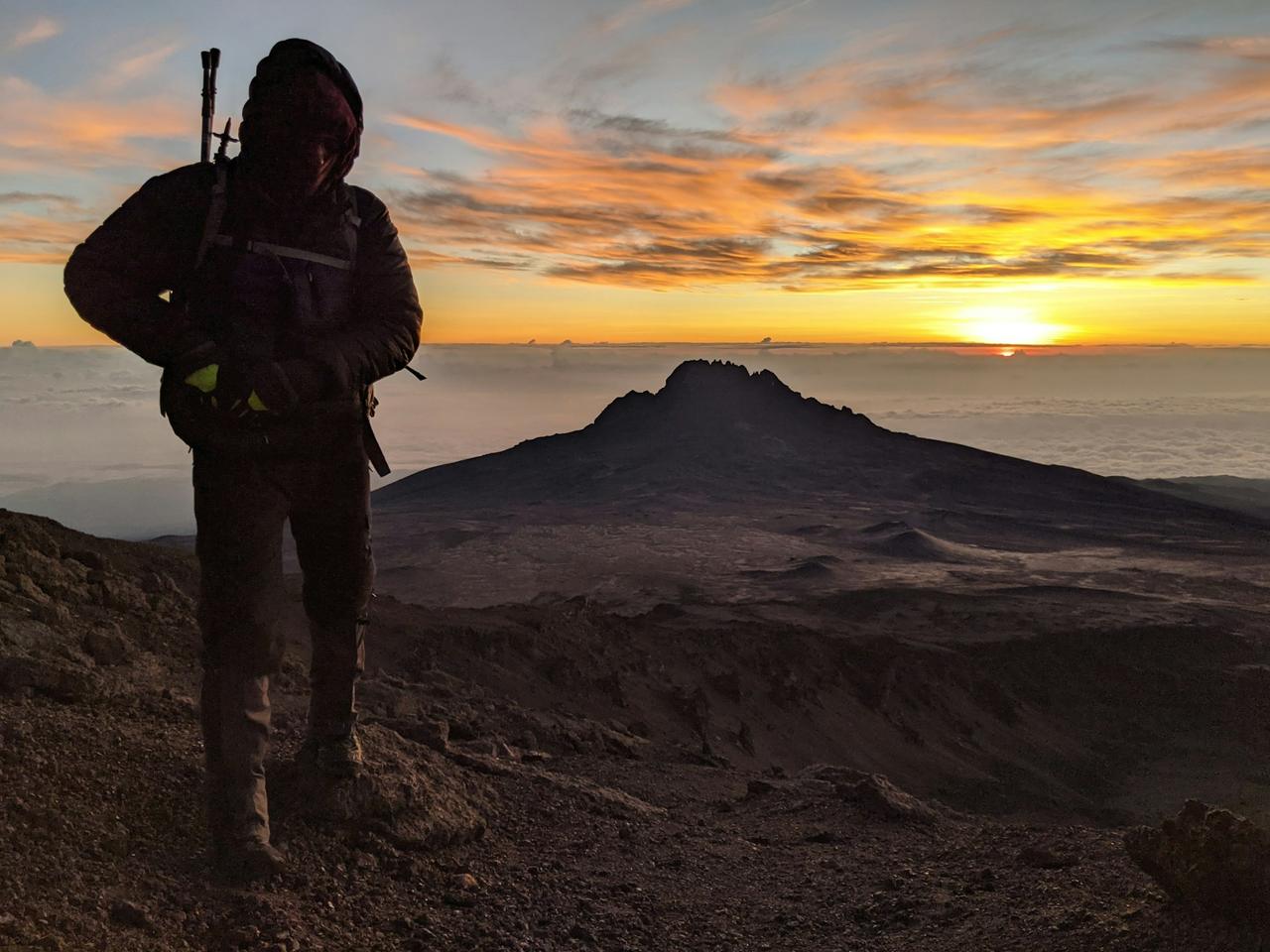
Kilimanjaro’s names and legends: The stories behind the mountain
Nobody knows for certain what “Kilimanjaro” means: traders on the Swahili coast used the name before Europeans came, and the Chagga named only its peaks. They also told stories about them: how Mawenzi got its jagged crown, why the dead faced Kibo, who lives above the snow.
The name: A name nobody can explain
No one knows for certain what “Kilimanjaro” means. Traders on the Swahili coast used the name long before Europeans arrived. The Chagga, who have farmed the mountain’s slopes for centuries, had no name for the whole mountain, only for its two peaks.
What it might mean
- 1860
“Mountain of greatness”
Swahili kilima, mountain, with njaro, read as greatness. Recorded on the coast by the missionary Johann Ludwig Krapf.
- 1860
“Mountain of caravans”
A landmark seen from far off by trading caravans: Krapf’s second reading.
- 1885
“White mountain”
The explorer Joseph Thomson thought njaro once meant white. The Maasai name, Ol Doinyo Oibor, does mean “the white mountain”.
- 1880s
“Mountain of the spirit Njaro”
On the coast, Njaro was said to be a spirit of the cold that guarded the summit.
- 1936
“The shining mountain”
A guess first printed in 1936 and repeated ever since, with nothing to back it.
- 1965
“It defeated the caravan”
From Chagga kilema, “it defeated”: proposed by a linguist in 1965, who left the question open himself. Often retold as “the impossible journey”.
Names on the mountain
- Kibo
- The Chagga name for the summit dome, recorded as meaning “snow”, “the bright one” or “spotted”, for dark rock showing through the snow.
- Mawenzi
- From the Chagga Kimawenze, read as “the dark one” or “the one with the broken top”.
- Shira
- Named after a Chagga district on the western slopes.
- Uhuru Peak
- Swahili for “freedom”, after Tanganyika’s independence in 1961. Hans Meyer had named it Kaiser-Wilhelm-Spitze in 1889.
- Ngàje Ngài
- “The House of God”: what a Maasai called the mountain, according to Joseph Thomson in 1885. Hemingway borrowed the words in 1936.
- Gilman’s and Stella Point
- Rim points named after early climbers: the surveyor Clement Gillman, who reached the rim in 1921, and Stella Latham, in 1925.
- Reusch Crater
- The inner crater, named after Pastor Richard Reusch, who climbed Kibo more than 25 times from 1926.
Legends: Stories told on its slopes
The Chagga have told stories about Kibo and Mawenzi for generations, and missionaries wrote many of them down around 1900. Other tales came from the Swahili coast, from colonial writers and from Hemingway. Here are the best known, with where each one comes from.
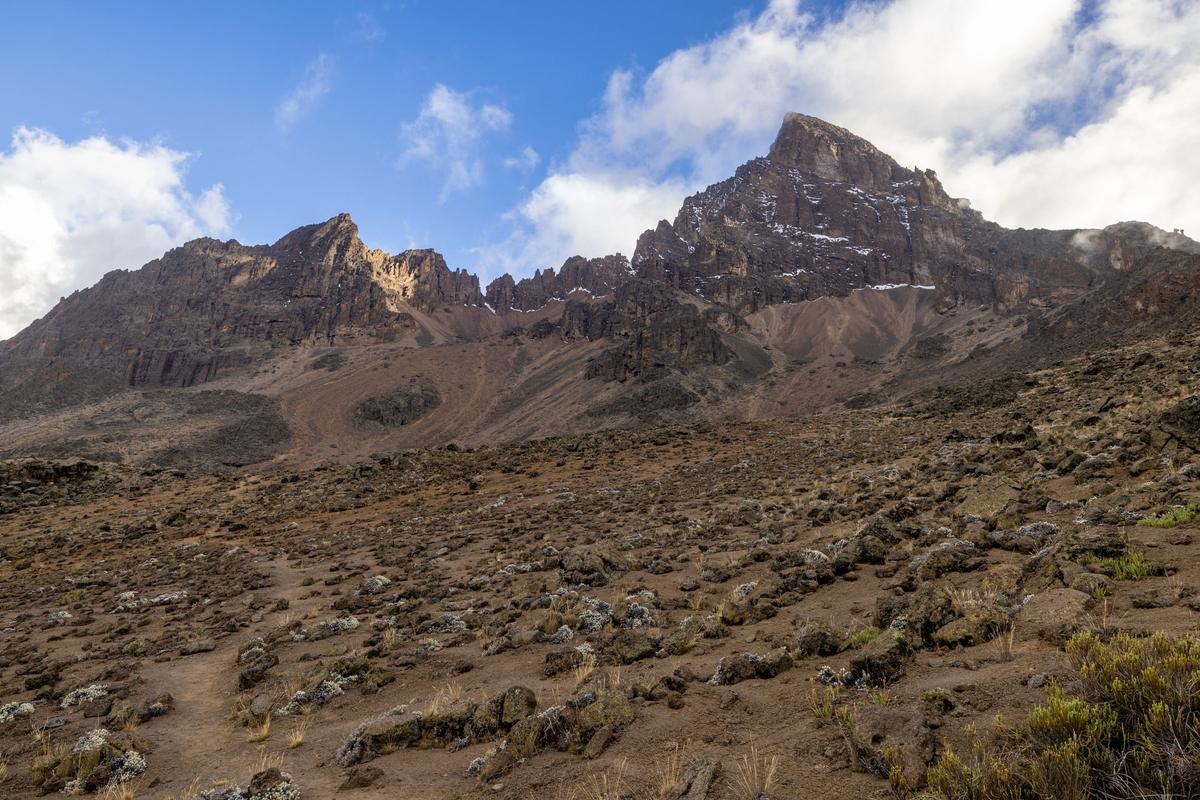
Photo: Balazs Simon / Pexels
Why Mawenzi is jagged
Mawenzi’s fire had gone out, so he went to borrow embers from his neighbour Kibo, who was pounding dried bananas and gave him some to take home. The bananas tasted so good that Mawenzi put out his fire on the way back and came again, and again. On the third visit Kibo lost patience and beat him with the pestle, and Mawenzi still wears the dents.
Chagga tale, written down by Johannes Raum (1910) and Bruno Gutmann (1914)
How the two peaks were pushed apart
Once Kibo and Mawenzi stood shoulder to shoulder. A poor man named Mlai crossed the mountain to seek his luck and was given a fine herd of cattle, but Kibo would not let him drive it home. An old woman gave him a magic powder: he blew it against the rock, the two peaks stepped apart, and he drove his cattle home through the gap.
Chagga tale, written down by Bruno Gutmann (1914)
“Kibo, help me!”
People once climbed through the forest to the meadows below Kibo to gather salt from the rocks. One man carried two loads, one for each of his wives, fell behind and sang to Kibo for help, promising it a cow. His kinsmen found him dead in the cold. The tale shows the Chagga knew the high mountain long before any European climbed it.
Chagga tale, written down by Bruno Gutmann (1914)
Facing Kibo
A Chagga man was buried in his hut with his face turned towards Kibo, and a small hole was cut in the wall so that he could always see it. Kibo stood for beauty and lasting friendship; jagged Mawenzi for the opposite.
Chagga custom, described by Moritz Merker (1902), Johannes Raum (1910) and Bruno Gutmann
The little people above Kibo
Above Kibo live the Wakonyingo, tiny people with huge heads who sleep sitting up, each with a horn to call for help if they topple over. Visitors who treat them with respect come home rich in cattle; those who mock them come home with nothing.
Chagga tales, written down by Bruno Gutmann (1914)
Mawenzi’s thunder
Mawenzi was said to thunder before the death of a chief of Kibosho. In July 1912 a tremendous crash, probably a collapsing rock tower, echoed round the mountain, and the chief Sianga died soon after.
Chagga belief, recorded by Bruno Gutmann (1914)
The silver on the summit
On the coast it was said that the white on the summit was silver, guarded by spirits who froze the hands and feet of anyone who came near. Rungua, king of Machame, once sent a large party up to fetch it. Only one man came back, his hands and feet crippled by frost.
Told to the missionary Johannes Rebmann, 1848–49
King Menelik’s treasure
Menelik I, the son of King Solomon and the Queen of Sheba, is said to have climbed into the crater to die, taking his treasure with him; later versions add Solomon’s ring, which would give its finder Solomon’s wisdom. The story was first printed by Pastor Richard Reusch in the 1930s, from tales of Ethiopian soldiers. No older source is known.
A 20th-century legend, first written down by Richard Reusch
Books, film and music: Far beyond Africa
Few mountains have travelled so far from home. Where Kilimanjaro turns up, and what is true in it.
- 1885
Through Masai Land
The explorer Joseph Thomson calls Kilimanjaro “the Mount Olympus of these parts” and prints the Maasai words Ngàje Ngài, “the House of God”.
- 1889
A cannon in the mountain
In Jules Verne’s novel Sans dessus dessous (“Topsy-Turvy”), a club of American gunners bores a giant cannon into Kilimanjaro to tilt the Earth’s axis.
- 1936
The Snows of Kilimanjaro
Ernest Hemingway’s short story opens with the frozen leopard near the summit. He never climbed the mountain: his safari of 1933–34 ended with a flight to Nairobi, which became the story’s ending.
- 1952
The film
Gregory Peck, Susan Hayward and Ava Gardner star in the Hollywood version. Its release in Japan is said to have made “Kilimanjaro” the name of a coffee there, which it still is.
- 1966
Kilimandjaro
Pascal Danel’s song, inspired by the film, becomes a French hit. In French, “les neiges du Kilimandjaro” still means the song as much as the story.
- 1982
Africa
Toto’s hit pictures Kilimanjaro rising above the Serengeti, which lies a few hundred kilometres away. Its writer had never been to Africa.
- Today
Tanzania’s coat of arms
The national coat of arms shows a warrior’s shield standing on Kilimanjaro, held by a man and a woman, with the motto Uhuru na Umoja: “freedom and unity”.
Questions: Names and legends, answered
What does Kilimanjaro mean?
No one knows for certain. The name was used on the Swahili coast before Europeans arrived, and has been read as “mountain of greatness”, “mountain of caravans” or “white mountain”, among other guesses. The Chagga, who live on the mountain, had names only for its two peaks, Kibo and Mawenzi.
What do Kibo and Mawenzi mean?
They are Chagga names. Kibo has been recorded as meaning “snow” (1860), “the bright one” (1891) and “spotted”, for dark rock showing through the snow (1965). Mawenzi, from Kimawenze, has been read as “the dark one” or “the one with the broken top”. None of these is settled.
What is the Chagga legend of Kibo and Mawenzi?
Mawenzi’s fire went out, so he went to borrow embers from Kibo, who gave him some, with dried bananas. Mawenzi liked the bananas so much that he put out his fire again and came back, twice. The third time Kibo beat him with the pestle he was pounding bananas with, and Mawenzi still wears the dents. The tale was written down by Johannes Raum in 1910 and Bruno Gutmann in 1914.
What does “Ngàje Ngài” mean?
“The House of God”: the explorer Joseph Thomson wrote in 1885 that a Maasai called the mountain this, and the Maa words for house and God fit. Hemingway borrowed it for his story in 1936. The Maasai name that is well recorded is Ol Doinyo Oibor, “the white mountain”.
Was the frozen leopard on Kilimanjaro real?
Yes. The dried, frozen body of a leopard lay on the crater rim from the mid-1920s, and the climber H. W. Tilman photographed it there in 1933. Nobody knows what brought it so high. Hemingway opened “The Snows of Kilimanjaro” with it in 1936.
Did Hemingway climb Kilimanjaro?
No. His safari of 1933–34 crossed Kenya and Tanganyika and ended when he fell ill and was flown to Nairobi, a flight that became the ending of “The Snows of Kilimanjaro” (1936). He saw the mountain, but never climbed it.
Sources
Updated
Ages, heights and sizes come from published geological studies and surveys; legends from the earliest written versions we could find; records from Guinness World Records and Fastest Known Time, checked in October 2026.
- Names and legends
- Thomson (1885): Through Masai Land
- Merker (1902): Rechtsverhältnisse und Sitten der Wadschagga
- Raum (1910): Land und Leute am Kilimandscharo
- Gutmann (1914): Volksbuch der Wadschagga
- Tilman (1937): Snow on the Equator (the leopard on the crater rim)
- Hutchinson (1965), Tanganyika Notes and Records 64: the meaning of Kilimanjaro
- Temple (1995), Alpine Journal: ancient and modern, some East African mountain myths
- Books, film and music
- Wikipedia: The Snows of Kilimanjaro (short story, 1936)
- Wikipedia: The Snows of Kilimanjaro (film, 1952)
- Wikipedia (Japanese): Kilimanjaro coffee
- Wikipédia: Kilimandjaro (chanson de Pascal Danel, 1966)
- Wikipédia: Sans dessus dessous (Jules Verne, 1889)
- Wikipedia: Africa (Toto song, 1982)
- Wikipedia: Coat of arms of Tanzania