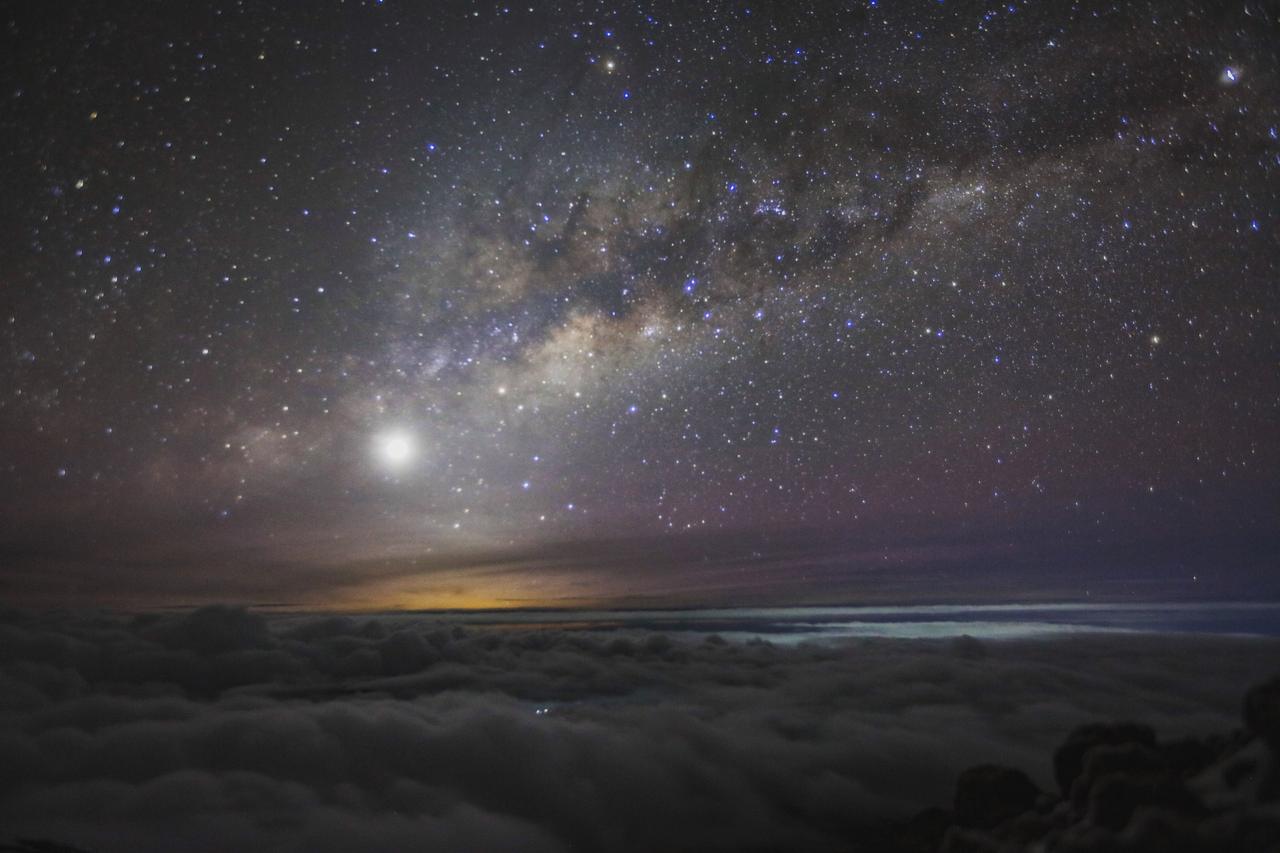
Kilimanjaro summit night: The longest night, hour by hour
You leave the high camp around midnight and climb about 1,200 m by headlamp, into air that sits at −8 °C at the top all night. Most groups reach the crater rim around first light and Uhuru Peak an hour or two later, then walk down for most of the day. It is the hardest day of the climb, and the one nobody forgets.
The night in one picture: Up in the dark, down in the sun
Every summit night has the same shape: six or seven hours up through the dark, a short walk along the crater rim at sunrise, then almost the whole day going down. The lines show a group at an ordinary pace; real groups run up to an hour or two either side of them.
- From Barafu Camp
- From Kibo Hut
- From School Hut
- 6–8 hup to Uhuru Peak
- 1–2 hfrom the rim to the top
- 2.5–3.5 hback down to the high camp
- 2–4 hon to the next camp
Hour by hour: From the high camp to the roof of Africa
What happens, what you feel and what to do, from dinner at the high camp to bed the next evening. Pick your high camp to see its times and places.
- Barafu Camp4,673 mKibo Hut4,720 mSchool Hut4,800 m
An early night at the high camp
You reach the high camp around midday. Dinner comes early, around five, with a briefing from your guide: when you will be woken, what to wear, what to carry. You are in your sleeping bag by seven or eight, often while it is still light. Few people sleep much: up here sleep is light and broken, and nerves, cold and other groups do the rest. Don’t worry about it: lying still and warm is rest too.
Barafu means “ice” in Swahili: a big, rocky camp spread along a ridge, the starting point for most climbers.
Kibo Hut is a stone bunkhouse at the foot of the summit cone; groups sleep in the hut or in tents beside it.
School Hut is a small camp on Kibo’s north-east flank, with far fewer climbers than the other two.
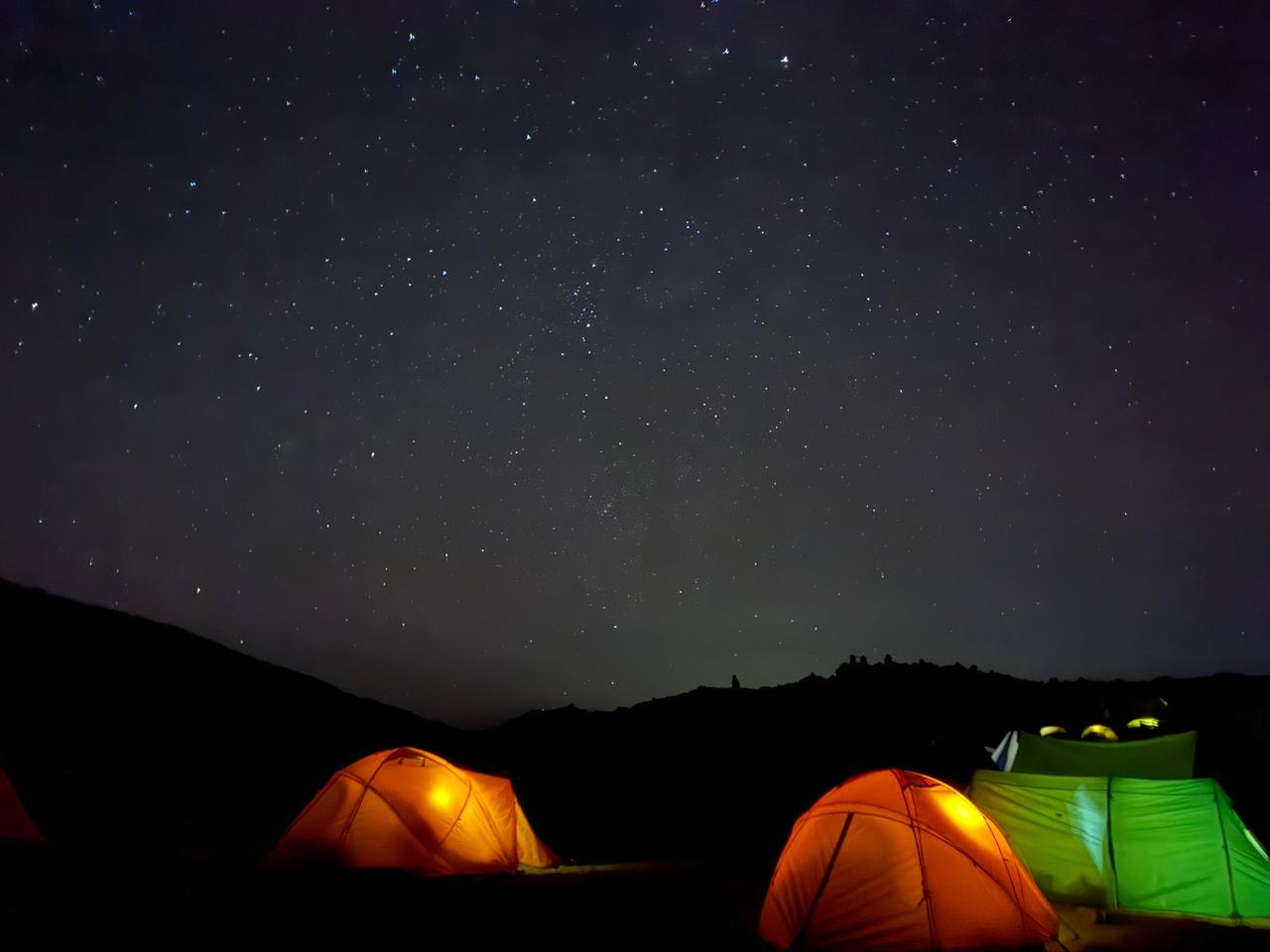
Lights on in camp before the start Photo: Никита Шелайкин / Pexels
How it feels
Excited, cold, a little nervous. A mild headache is common at this height.
Do this
- Lay out your summit clothes in the order you put them on.
- Keep batteries, phone and tomorrow’s base layer in your sleeping bag.
- Pack the daypack now: water bottles, snacks, spare gloves, headlamp on top.
- usually 11:00 PM–11:30 PMBarafu Camp4,673 mair about 0 °Cusually 10:15 PM–11:30 PMKibo Hut4,720 mair about −1 °Cusually 10:00 PM–11:00 PMSchool Hut4,800 mair about −1 °C
The wake-up call
A voice at the tent in the dark, a headlamp and a hot drink. Tea or coffee with biscuits or popcorn, sometimes porridge, then every layer you own. The crew fills your bottles with hot water, and the guides check each climber before the group sets off. It takes about an hour from waking to walking.
How it feels
Groggy and cold. Fingers fumble with zips and laces.
Do this
- Eat something even if you’re not hungry.
- Dress in the tent, not outside.
- Go to the toilet before you leave: there are none on the way up.
What you wear
Almost everything you brought. On top: a base layer, one or two fleeces, a down jacket and a windproof shell. On your legs: thermal leggings, fleece or insulated trousers and waterproof over-trousers. A warm hat, a buff, liner gloves under mittens, wool socks.
The summit-night outfit - usually 12:00 AM–12:30 AMBarafu Camp4,673 mair about −1 °Cusually 11:40 PM–12:30 AMKibo Hut4,720 mair about −1 °Cusually 11:00 PM–12:00 AMSchool Hut4,800 mair about −1 °C
Into the dark
The group leaves in single file, the guide in front setting a pace that feels absurdly slow: half-steps, hardly a word spoken. Above you a line of headlamps zigzags up the slope; below, the camp lights and, on clear nights, the glow of Moshi far down on the plains. The path climbs steeply from the first minutes and never lets up.
From Barafu a rocky ridge leads onto the long scree slope. Some groups sleep higher, at Upper Barafu (also called Kosovo Camp, about 4,800 m), and leave about an hour later.
From Kibo Hut the zigzags start at once, up the steep scree towards Hans Meyer Cave.
From School Hut the path climbs Kibo’s north-east flank and joins the Kibo Hut path just below Hans Meyer Cave.
How it feels
Too slow, and soon too warm. Neither lasts.
Do this
- Start cold: you warm up within minutes, and sweat chills you later.
- Keep the pace your guide sets, however slow it feels.
Why at midnight?
- Sunrise on top
- Leave around midnight and you reach the rim around dawn.
- Daylight for the way down
- After the summit you still go down 2,795 m; a midnight start leaves the whole day for it.
- Clear morning views
- Cloud usually builds on the slopes from late morning, mostly below the rim.
- Frozen ground
- Guides say the scree is firmer while it is frozen.
It isn’t compulsory: some longer itineraries climb by day, or spend a night in the crater at Crater Camp (about 5,730 m). They add a day, cost an extra park fee for the crater, and are not easier.
- 5,010 mair about −3 °CHans Meyer Cave5,250 mair about −4 °CHans Meyer Cave5,250 mair about −4 °C
Finding the rhythm
The hours settle into a pattern: step, breathe, step. The first stop often comes after an hour and a half, then a few minutes about once an hour: long enough to drink and eat a bite, short enough not to get cold. Most groups climb 150–200 m an hour, stops included. It grows colder as you go, not because the night gets colder but because you climb into colder air: about a degree for every hour.
Hans Meyer Cave, a rock overhang at about 5,250 m, is the usual first long rest.
Just below Hans Meyer Cave, a rock overhang at about 5,250 m, the School Hut path joins the busier Kibo Hut path.
How it feels
Warm while you walk, cold within minutes of stopping.
Do this
- Breathe slowly and deeply, in time with your steps.
- Drink at every stop, even a few sips.
- Put the down jacket on when you stop, and take it off before you walk on.
Pole pole: the pace
Slow is the technique, not a weakness. Take short steps and let your weight rest for a moment on the straight back leg before the next step. Breathe with your steps, slowly and deeply: in one study at 4,559 m, six slow breaths a minute raised climbers’ blood oxygen from about 80% to 90% while they kept it up.
- 5,350 mair about −5 °C5,520 mair about −6 °C5,420 mair about −5 °C
The low hours
Between about three and six the night is at its hardest. The slope is at its steepest and loosest, the air at its coldest, and your body is at its daily low, the hours when people are sleepiest even at home. Many climbers feel sick, can’t face food, or doze off at stops and even on their feet; hands and toes ache with cold. Guides watch each climber closely now, and this is where most people dig deepest.
Above Hans Meyer Cave the zigzags steepen into the boulders of Jamaica Rocks, the last scramble below Gilman’s Point.
Above Hans Meyer Cave the zigzags steepen into the boulders of Jamaica Rocks, the last scramble below Gilman’s Point.
How it feels
Every step an effort. Thoughts shrink to the next step.
Do this
- Don’t look up for the rim: count steps or breaths instead.
- Tell your guide honestly how you feel. Confusion, stumbling or a severe headache mean going down.
- Keep a snack and a bottle inside your jacket so they don’t freeze.
How cold it gets, hour by hour
At the top the air hardly changes all night: about −8 °C from midnight to sunrise, coldest around dawn, and the same in every month of the year. What you feel getting colder is the height: you climb from air around freezing at camp into air at −8 °C.
- At the top (5,895 m)
- Around you, from Barafu Camp
The night wind at the top averages about 16 km/h, and blows hard on only a few nights. In that wind −8 °C feels like −15 °C; on the coldest dawns it feels like −16 to −20 °C.
Fingers and toes are the risk, not your face: keep gloves dry, boots not too tight, and stops short.
What the height does to you
- 58%air pressure of sea level at the high camp, 49% at the top
- 76%average blood oxygen measured at Stella Point
- 86%had altitude sickness on summit day in one study, 7% the day after, once down
- 5,000kcal burned on summit day, while appetite drops by about a quarter
The thin air slows everything: your pace, your thinking, your appetite. Headache, nausea and tiredness are common tonight. They are reasons to tell your guide, and, if they get worse, to go down.
Altitude sickness: the signs - 5,560 mair about −6 °C5,660 mair about −7 °C5,570 mair about −6 °C
First light
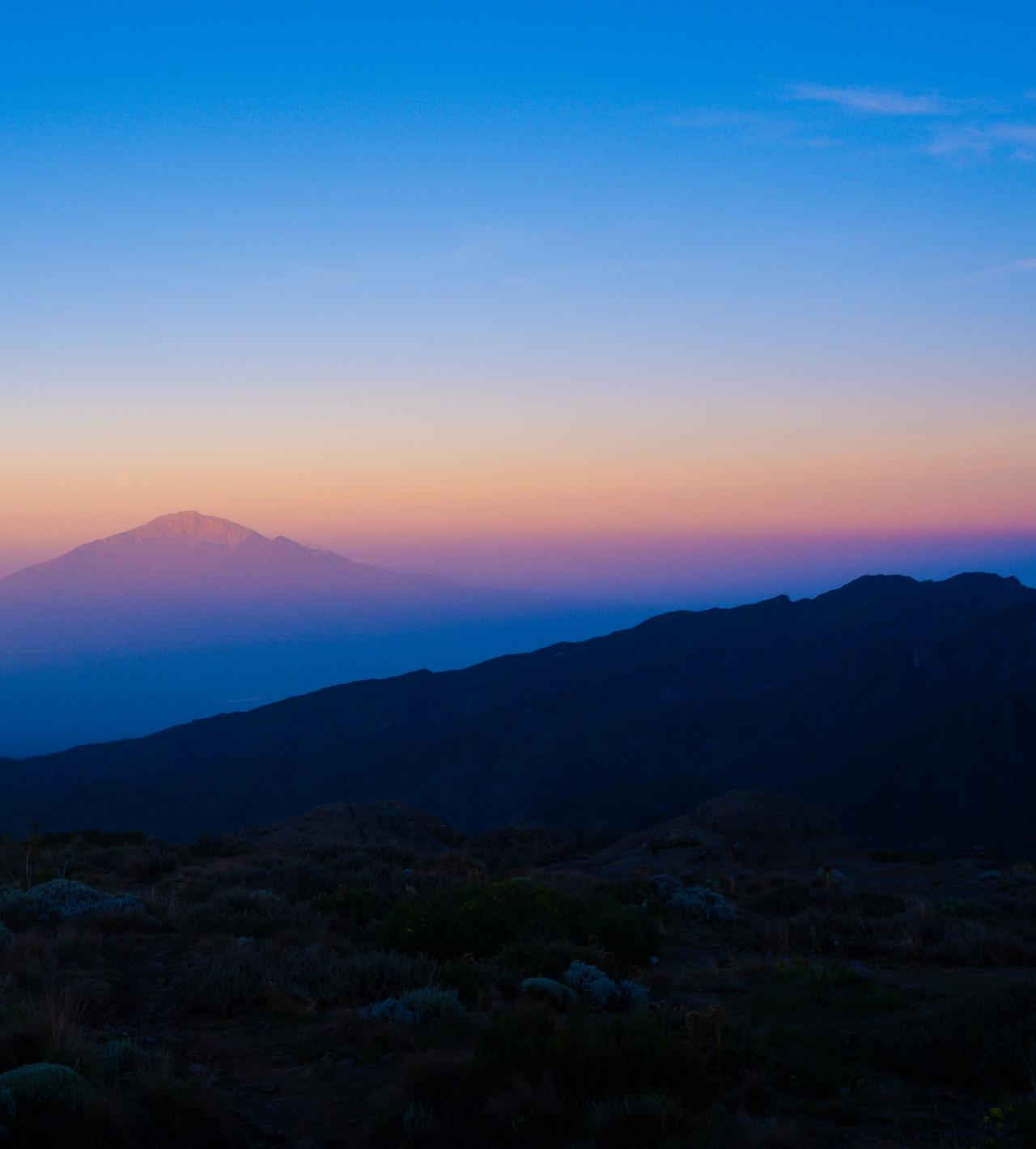
Behind Mawenzi, the jagged peak to the east, the horizon turns from black to deep blue, then a thin band of orange. From this high up, dawn comes about ten minutes earlier than at the foot. The light changes everything: fingers come back to life, you can see the rim, and the end feels in sight.
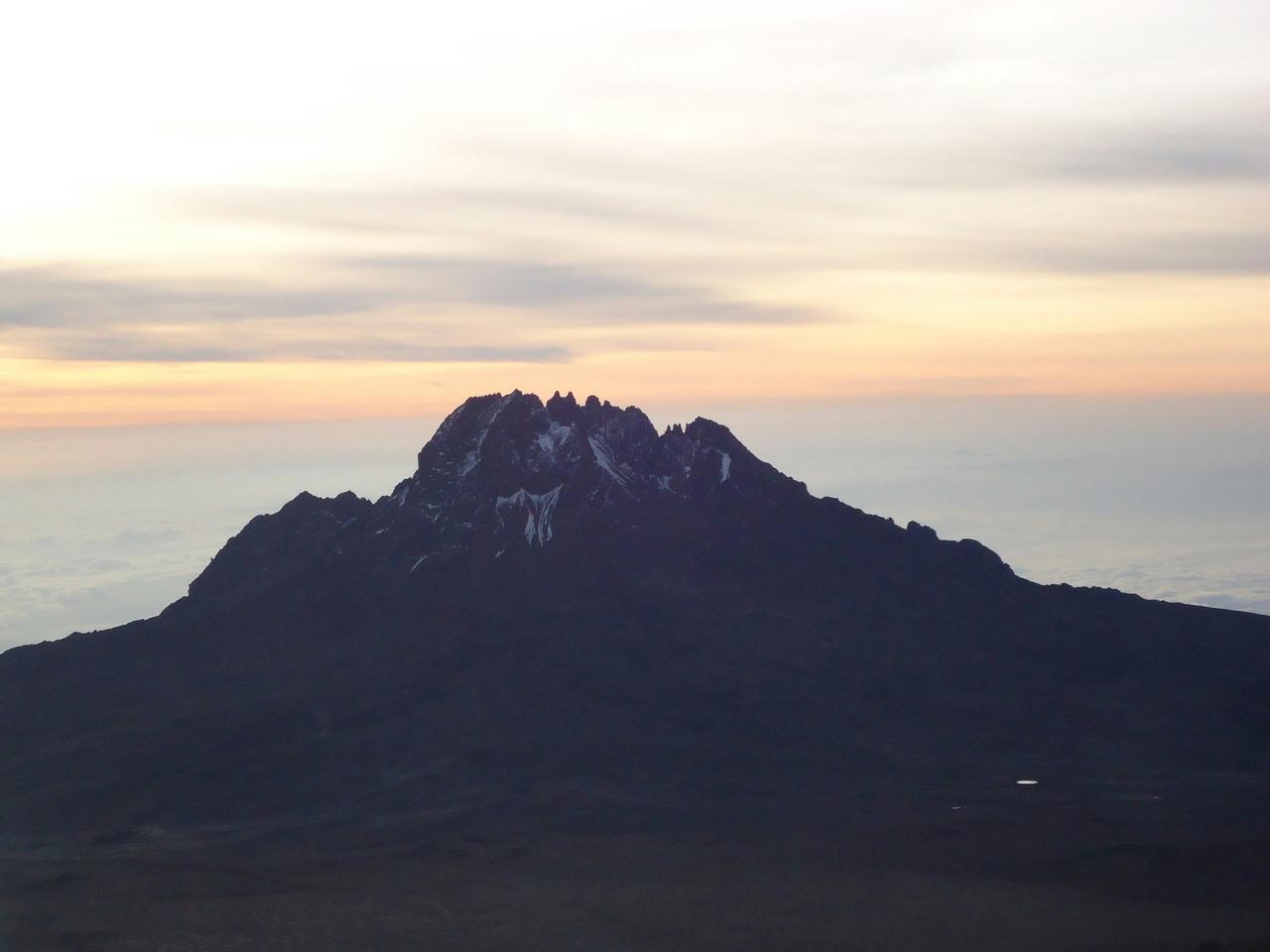
Mawenzi before sunrise, from the summit path Photo: Zameer Khan / Unsplash
How it feels
Relief, and often a second wind.
Do this
- Keep your headlamp on until the guide says so: the ground is loose.
- Have your phone warm in an inside pocket, ready for the sunrise.
Sunrise on the summit, month by month
From the crater rim the sun comes up about eleven minutes earlier than at the foot, because you see over the curve of the Earth.
Dawn and sunrise seen from the crater rim, mid-month, Tanzanian time Month Sky pales Headlamps off Sunrise at the top Sunrise at the foot Jan 5:06 AM 5:58 AM 6:20 AM 6:31 AM Feb 5:17 AM 6:06 AM 6:28 AM 6:39 AM Mar 5:16 AM 6:04 AM 6:25 AM 6:36 AM Apr 5:09 AM 5:58 AM 6:19 AM 6:29 AM May 5:04 AM 5:55 AM 6:16 AM 6:28 AM Jun 5:06 AM 5:59 AM 6:21 AM 6:33 AM Jul 5:12 AM 6:04 AM 6:26 AM 6:38 AM Aug 5:13 AM 6:03 AM 6:24 AM 6:35 AM Sep 5:04 AM 5:52 AM 6:13 AM 6:23 AM Oct 4:51 AM 5:40 AM 6:01 AM 6:11 AM Nov 4:43 AM 5:34 AM 5:56 AM 6:07 AM Dec 4:49 AM 5:42 AM 6:05 AM 6:17 AM On the night of a full moon, and for about six nights after, the moon is up for the whole climb and lights the slope; some climbers hardly need a headlamp. On the nights before full moon it sets during the climb, earlier each night. Full-moon nights are popular: expect a busier trail and a queue at the summit sign. Full-moon dates
- usually 5:30 AM–7:15 AMStella Point5,756 mair about −7 °Cusually 4:30 AM–6:30 AMGilman’s Point5,685 mair about −7 °Cusually 5:30 AM–7:00 AMGilman’s Point5,685 mair about −7 °C
The crater rim
You stand on the crater rim, and the steepest climbing of the whole trek is behind you. Guides hand round hot tea; many climbers cry. Seen from up here the sun rises between 5:56 AM and 6:28 AM, depending on the month. Fast groups watch it from the rim, some even reach the rim in the dark; many see the sunrise from the last slope below. All of that is normal. The rim feels like the top, but it isn’t: Uhuru Peak is still ahead.
Stella Point, 5,756 m. Uhuru Peak is 139 m higher and about 1.1 km along the rim: about an hour.
Gilman’s Point, 5,685 m. Uhuru Peak is 210 m higher and about 2 km along the rim, past Stella Point: one and a half to two hours.
Gilman’s Point, 5,685 m. Uhuru Peak is 210 m higher and about 2 km along the rim, past Stella Point: one and a half to two hours.
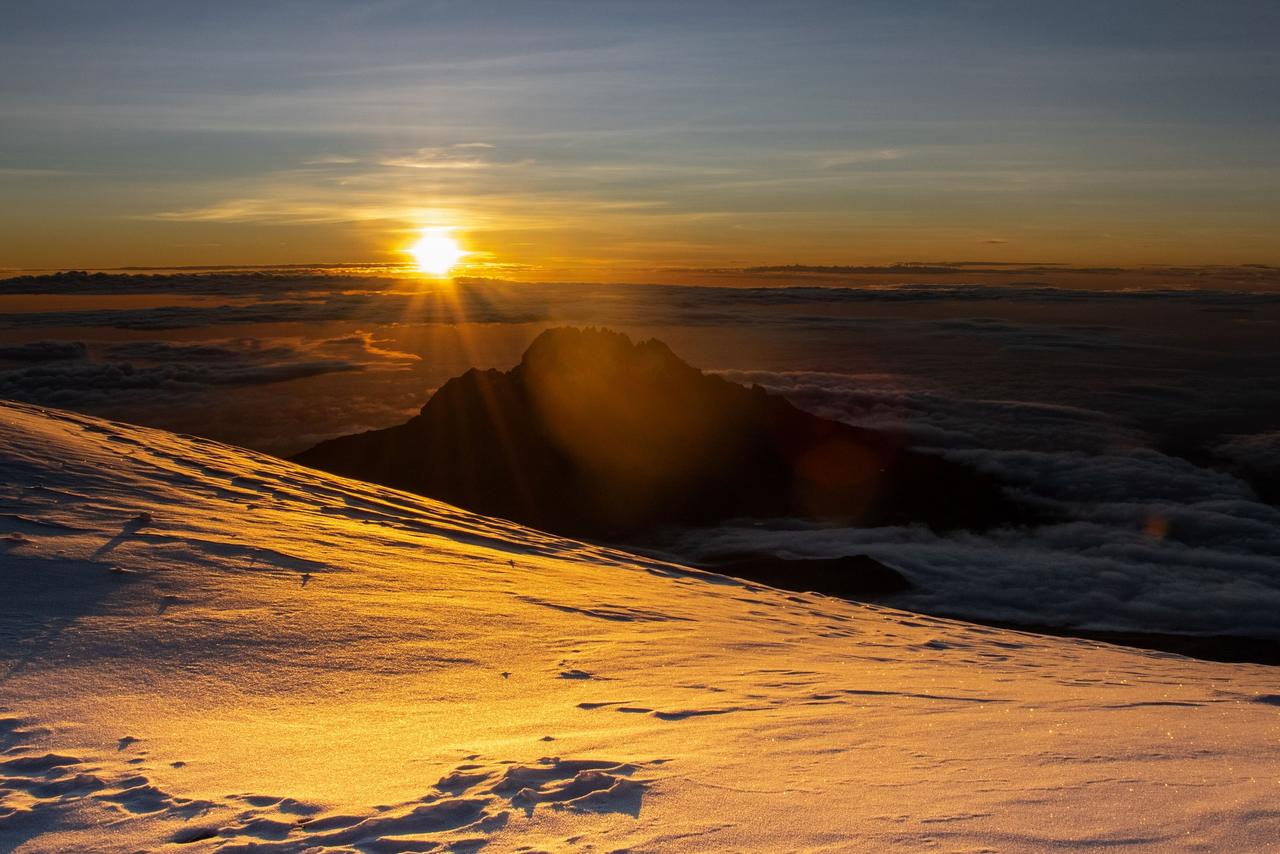
Sunrise from the crater rim Photo: Paweł Kosmala / Pexels
How it feels
Exhausted and elated at once.
Do this
- If you are fading, say so: reaching the rim counts, and the park issues a certificate for it too.
From the rim to the top
From the rim to the top Higher Along the rim Usually Stella Point → Uhuru Peak +139 m 1.1 km 0.8–1 h Gilman’s Point → Uhuru Peak +210 m 2 km 1.5–2 h - usually 6:30 AM–8:15 AMUhuru Peak5,895 mair about −8 °Cusually 5:45 AM–8:00 AMUhuru Peak5,895 mair about −8 °Cusually 6:00 AM–8:30 AMUhuru Peak5,895 mair about −8 °C
Uhuru Peak
The last stretch follows the rim, gently uphill, with the ice cliffs of the glaciers on one side and the wide crater on the other. The top is in sight and never seems to get closer: up here the air pressure is 49% of sea level, and many find this the longest hour of the night. Then the wooden sign: Uhuru Peak, 5,895 m, the highest point in Africa. Most groups stay about twenty minutes, long enough for photos and a hug, short enough not to get cold.
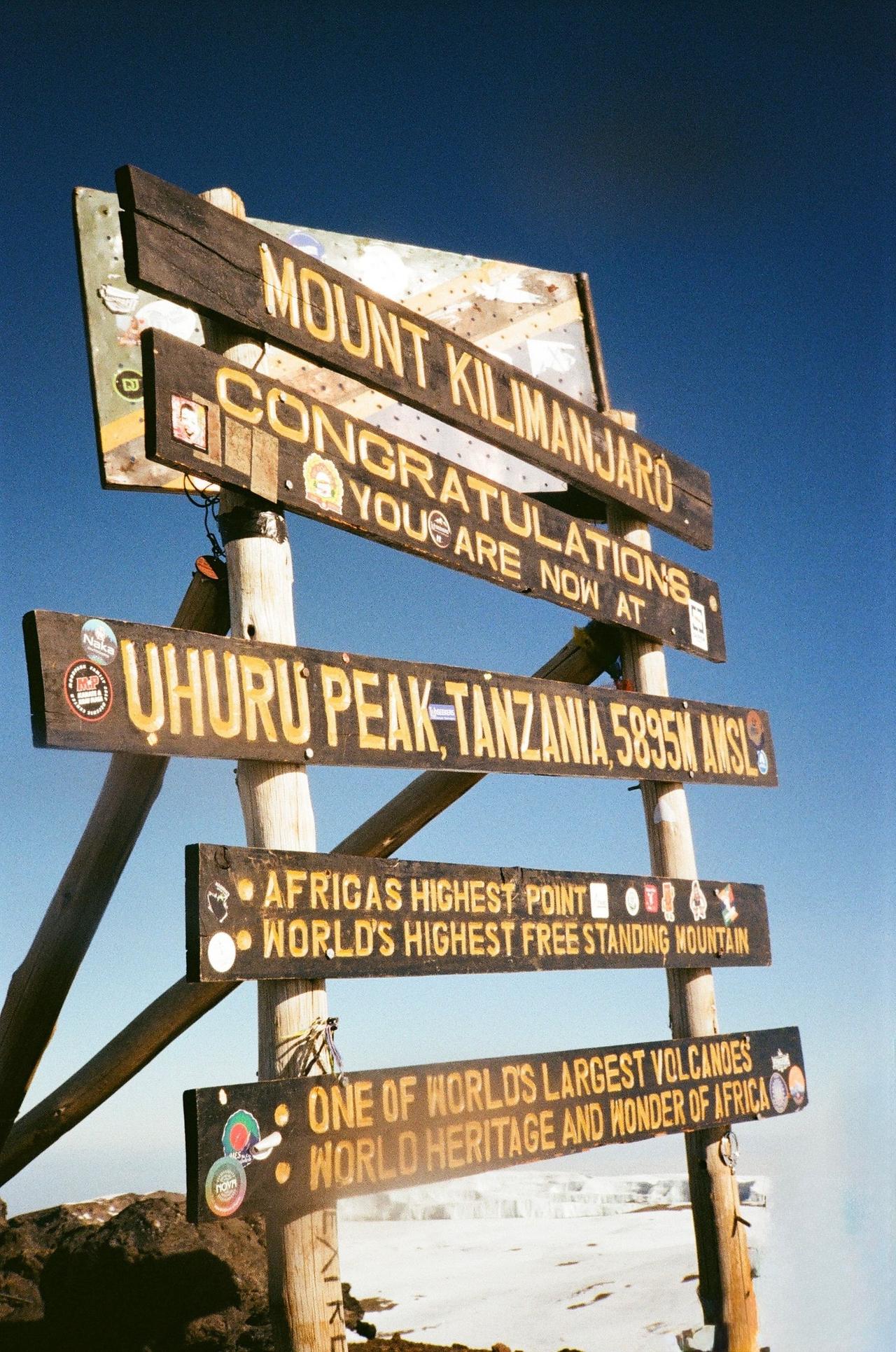
The sign on Uhuru Peak Photo: Marina Zvada / Pexels
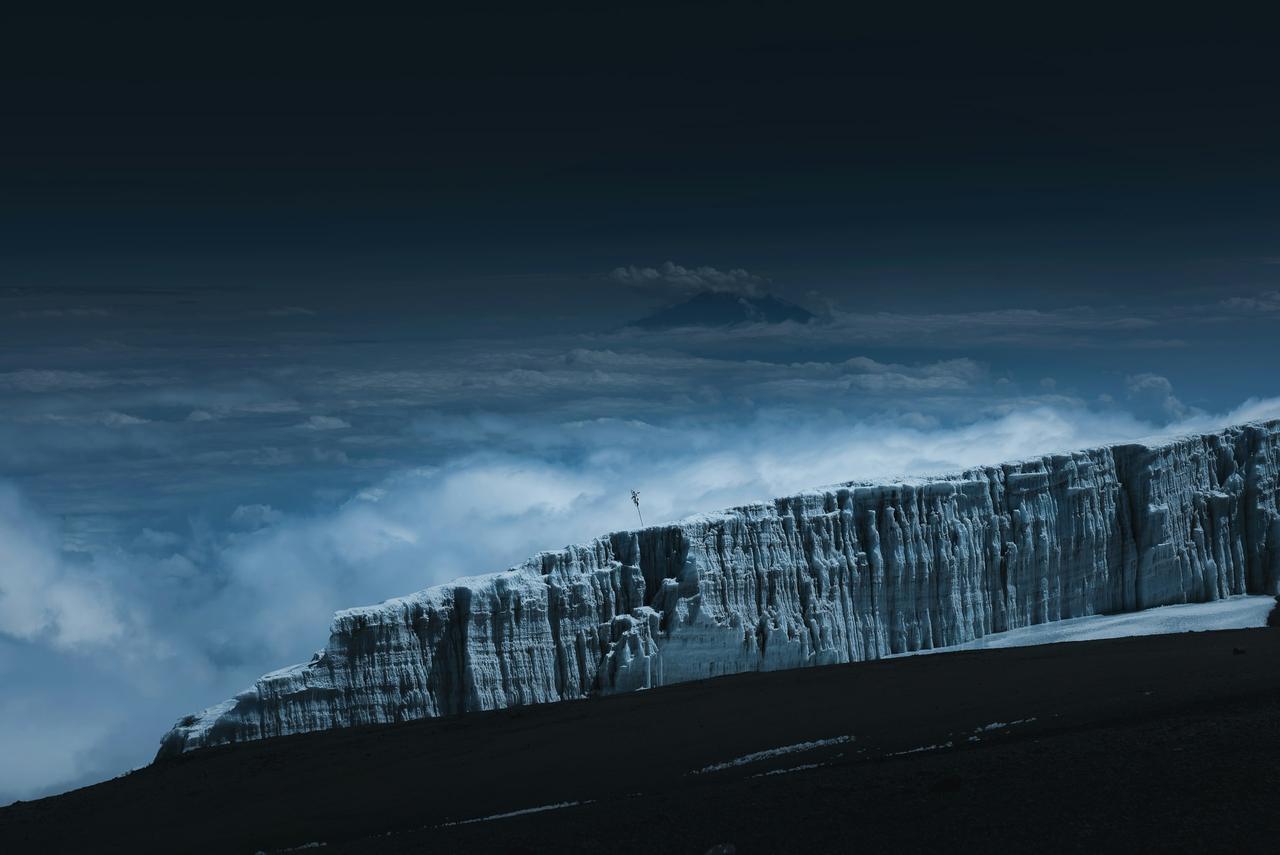
The summit ice beside the rim path How it feels
Joy, tears, exhaustion. For some it only sinks in days later.
Do this
- Take your photos quickly: on busy mornings there is a queue at the sign.
- Thin liner gloves let you use the phone without bare hands.
- Sunglasses on: the glare off the ice starts here.
- Uhuru Peak5,895 mair about −8 °CUhuru Peak5,895 mair about −8 °CUhuru Peak5,895 mair about −7 °C
Down the scree
You go back along the rim and down the slope you climbed in the dark, now often straight down through the scree instead of on the zigzags. Guides show you how to dig in your heels and let the gravel carry you. It is far quicker than the way up, but many climbers find it harder: you are exhausted, and walking downhill roughly doubles the load on your knees. As the sun climbs, layers come off and the glare grows fierce.
You go down past Hans Meyer Cave to Kibo Hut; the scree below Gilman’s Point is steep and loose.
School Hut climbers go down the other side, past Stella Point to Barafu Camp.
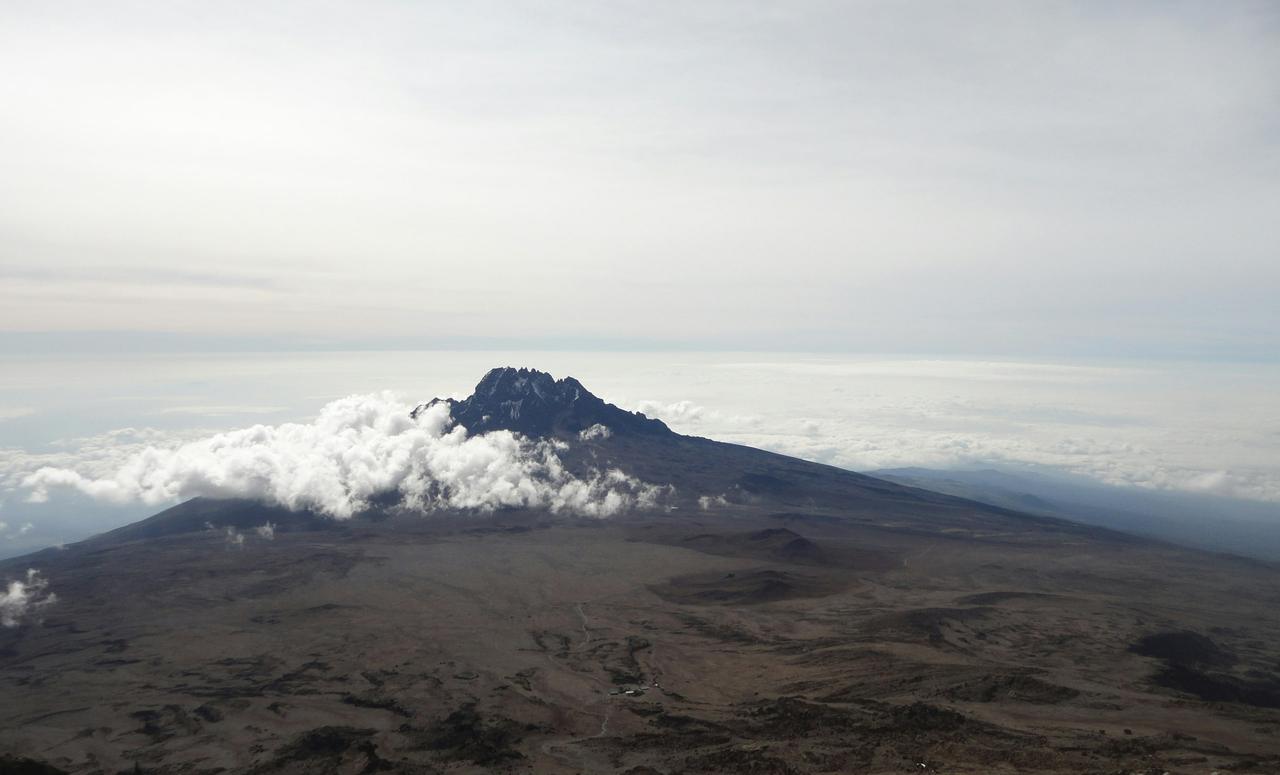
The long way down, in daylight Photo: Zameer Khan / Unsplash
How it feels
Tired legs, sore toes, a dusty throat, a huge grin.
Do this
- Poles cut the load on your knees by 12–25%: lengthen them for the descent.
- Gaiters keep the gravel out of your boots.
- Sunglasses and sunscreen on before the sun is high: by mid-morning the UV up here is extreme.
- usually 9:40 AM–12:00 PMBarafu Camp4,673 mair about 2 °Cusually 9:45 AM–11:00 AMKibo Hut4,720 mair about 2 °Cusually 10:00 AM–12:30 PMBarafu Camp4,673 mair about 2 °C
Back at camp
Porters often come up to meet you with juice. The cook has a hot meal waiting and your tent is still up. The rest is shorter than people expect, usually one to two hours, and many climbers fall asleep in their boots. The porters, who stayed in camp, pack up around you.
Back at Barafu Camp, about three hours after leaving the top.
Back at Kibo Hut, about three hours after leaving the top.
Lunch and a rest at Barafu Camp: the Northern Circuit goes down the Mweka side.
How it feels
Hungry at last, and desperate for sleep.
Do this
- Drink and eat what you can: there are still hours of walking ahead.
- Change into dry socks and a fresh layer.
- usually 12:15 PM–2:30 PMBarafu Camp4,673 musually 11:30 AM–1:15 PMKibo Hut4,720 mair about 2 °Cusually 12:15 PM–2:30 PMBarafu Camp4,673 m
Down to thicker air
Early in the afternoon you set off again, down a rocky path through the alpine desert into the heather. With every hour the air thickens and warms. Headaches fade, and appetite comes back. Afternoon weather often turns: cloud, rain, sometimes snow.
To Mweka Camp (3,100 m, three to four hours) or, for some groups, Millennium Camp (also called High Camp, about 3,800–3,950 m, two to three hours).
Back across the alpine desert to Horombo Huts (3,720 m), about 9 km: two to three hours.
To Mweka Camp (3,100 m, three to four hours) or Millennium Camp (also called High Camp, about 3,800–3,950 m).
How it feels
Lighter with every hundred metres.
Do this
- Keep the poles out: tired legs trip on rocks.
- Keep the rain jacket at the top of your pack.
- usually 3:30 PM–6:00 PMMweka Camp3,100 musually 2:30 PM–6:30 PMHorombo Huts3,720 musually 3:30 PM–6:00 PMMweka Camp3,100 m
The best sleep of the climb
You reach camp in the late afternoon, about sixteen hours after you set off, sometimes at dusk. Dinner, a celebration with the crew, and the deepest sleep of the week: many are asleep before the plates are cleared. The next morning a last walk takes you down through the forest to the gate, where the certificates are handed out.
How it feels
Proud, sore and very, very tired.
Do this
- Thank your crew: summit day is the hardest day for them too.
Three ways up: Your high camp, your night
Every route ends on one of three summit paths. They reach the crater rim at different points and share the last stretch to Uhuru Peak. The times are those on the park’s own signboards at each camp.
Barafu Camp
4,673 m- Uhuru Peak5,895 m7:15 AM5 km · 7 h from camp
- Stella Point5,756 m6:30 AM4.3 km · 6 h from camp
- Barafu Camp4,673 m12:00 AM
- Summit day
- 17 km · +1,222 m / −2,795 m
- You sleep at Mweka Camp, 3,100 m
- You sleep at Mweka Camp, 3,100 m
Kibo Hut
4,720 m- Uhuru Peak5,895 m7:00 AM6 km · 6 h from camp
- Gilman’s Point5,685 m5:15 AM4 km · 5 h from camp
- Hans Meyer Cave5,250 m2:30 AM
- Kibo Hut4,720 m12:00 AM
- Summit day
- 22 km · +1,175 m / −2,175 m
- You sleep at Horombo Huts, 3,720 m
- You sleep at Horombo Huts, 3,720 m
School Hut
4,800 m- Uhuru Peak5,895 m7:45 AM7 km · 7 h from camp
- Gilman’s Point5,685 m6:00 AM6 km · 6 h from camp
- Hans Meyer Cave5,250 m3:00 AM
- School Hut4,800 m11:30 PM
- Summit day
- 18 km · +1,095 m / −2,795 m
- You sleep at Mweka Camp, 3,100 m
- You sleep at Mweka Camp, 3,100 m
Other ways to the top
- Upper Barafu (Kosovo Camp)
- A higher camp above Barafu, at about 4,800 m: about an hour less climbing in the night and a later start, for an extra park fee.
- Crater Camp
- A night in the crater at about 5,730 m, after reaching the top by day. Cold and very high; many companies advise against it.
- Western Breach
- The steep scramble from the west into the crater has been closed since January 2024.
If you can’t go on: Turning back is part of the plan
No clock in the park rules decides when you turn round. Your guide does, with you, and the park’s own sign at Barafu Camp asks climbers to see going down as the better option when in doubt.
Who decides
Your head guide. Some companies set their own turnaround time, for example being on top by about ten in the morning, but it is company policy, not a park rule.
When to go down
A headache that gets worse, vomiting, confusion, stumbling or breathlessness at rest. Don’t hide symptoms to keep going: in the largest study, climbers who carried on with mild symptoms got severe ones twice as often.
What happens
An assistant guide walks you down while the group goes on; nobody waits alone. You rest at camp and go down to the lower camp with everyone in the afternoon.
The rim counts
In the largest study 92% reached the crater rim and 88% Uhuru Peak. The park’s certificate names the point you reached: Gilman’s Point, Stella Point or Uhuru Peak.
In your pockets: What to carry on summit night
Your guide carries the first-aid kit, a phone and emergency oxygen; you carry a light daypack. The trick is keeping things from freezing: what matters goes inside your jacket.
Water
Two litres in insulated bottles, filled with hot water and carried upside down so the cap doesn’t freeze. Drinking tubes freeze within half an hour to two hours.
Something hot
A small flask of sweet tea, if your crew doesn’t carry one.
Fast snacks
Sweets, gels or chocolate in an inside pocket: up here you eat less than you need, and you burn about 5,000 kcal today.
Headlamp
With spare lithium batteries: ordinary alkaline cells lose more than half their power around freezing.
Phone
In an inside pocket. Phones are made for 0–35 °C; the cold shuts them down, but they recover when warm.
Mittens and spares
Mittens over liner gloves, and a dry spare pair: cold hands are the most common complaint.
For the way down
Sunglasses (category 3 or 4), sunscreen and lip balm: the morning sun up here is extreme.
Poles and gaiters
Poles for the scree and your knees; gaiters to keep the gravel out of your boots.
Questions: Summit night, answered
What time does summit night start on Kilimanjaro?
Most groups are woken around 23:00 and leave the high camp around midnight, from Barafu Camp, Kibo Hut or School Hut alike. Groups that sleep higher, at Upper Barafu, leave about an hour later.
How long is summit night on Kilimanjaro?
About 6–8 h up to Uhuru Peak, 2.5–3.5 h back down to the high camp, a rest of an hour or two, then 2–4 h on to the next camp. From leaving the high camp to arriving at the next camp, most groups take 15–17 h, breaks included.
How cold is summit night on Kilimanjaro?
Measured at the top, the air is about −8 °C from midnight to sunrise in every month of the year, and coldest at dawn. In the usual night wind that feels like −15 °C, and on the coldest, windiest dawns like −16 to −20 °C. At the high camp it is around freezing when you leave.
Why do you climb Kilimanjaro at night?
To reach the crater rim around sunrise and to leave the whole day for the long way down: after the summit you still descend 2,795 m. Morning views are also clearer, before cloud builds on the slopes, and guides say the frozen scree is firmer.
What should I wear on summit night?
Almost everything you brought: a base layer, one or two fleeces, a down jacket and a windproof shell on top; thermal leggings, warm trousers and waterproof over-trousers on your legs; a warm hat, liner gloves under mittens and wool socks.
What time is sunrise on Kilimanjaro?
Seen from the crater rim or Uhuru Peak, between 5:56 AM (mid-November) and 6:28 AM (mid-February), about eleven minutes earlier than at the foot. Headlamps can go off about twenty minutes before that.
Will I see the sunrise from the top?
From the crater rim, or the last slope below it, most groups do. From Uhuru Peak itself only the fast ones: in climbers’ own reports about four in ten stood on the top before seven, and about one in three arrived after eight.
How far is it from Barafu Camp to Uhuru Peak?
About 5 km and 1,220 m of climbing, about seven hours on the park’s sign at the camp. From Kibo Hut it is 6 km and from School Hut 7 km, six to seven hours.
How long from Stella Point or Gilman’s Point to Uhuru Peak?
From Stella Point it is 139 m higher and about 1.1 km along the rim: about an hour. From Gilman’s Point it is 210 m higher and about 2 km: one and a half to two hours.
How long can you stay at the top of Kilimanjaro?
Usually fifteen to thirty minutes. It is cold, the air is thin and there is still a long way down, so guides move groups on after photos.
How long is the descent after the summit, and where do you sleep?
Two to three hours back down to the high camp, a rest, then three to four hours to Mweka Camp (3,100 m) or less to Millennium Camp; from Kibo Hut, two to three hours to Horombo Huts (3,720 m). In all you go down 2,175 m to 2,795 m in one day.
What happens if I can’t make it to the top?
An assistant guide takes you down while the group goes on, and you rest at camp until the others return. Reaching the crater rim earns a certificate too: the park issues them for Gilman’s Point, Stella Point and Uhuru Peak.
How many people reach the summit on summit night?
In the largest study on the mountain, 88% of climbers reached Uhuru Peak and 92% the crater rim. Longer itineraries do better. There is no official success rate.
Will my water freeze on summit night?
Drinking tubes and valves often do, within half an hour to two hours, and bottles can freeze too. Carry insulated bottles filled with hot water, upside down, inside your pack or jacket.
Is summit night dangerous?
It is the riskiest part of the climb: altitude sickness peaks on summit day, and most serious cases on the mountain begin at the high camp or on the way up. Going slowly, telling your guide how you feel and turning back when symptoms get worse keep it safe.
Sources
Updated
Times are typical for a group that leaves around midnight, from guides’ and climbers’ own reports and the park’s signboards; the temperatures come from weather stations on Kibo’s glaciers, and the dawn times are calculated for the crater rim. This page is not medical advice.
- Kilimanjaro: park and paths
- Mountains National Parks Regulations, GN 191 of 2003: guides, route procedures, rescue
- Kilimanjaro National Park visitor brochure: park rules and rescue services
- Kilimanjaro National Park (2023), 50 years magazine: routes up and down, minimum days, climber numbers
- Tanzania National Parks: tariff 2026/27 (Crater Camping, Upper Barafu camping)
- Kilimanjaro-Wiki: the park’s signboards at the camps and summits, dated photos
- Henry Stedman, Climb Mount Kilimanjaro: the Machame and Marangu routes, summit day
- Climbing Kilimanjaro: the Western Breach, closed by a park memo of 20 January 2024
- The Citizen (2017): the man behind the Kilimanjaro certificates
- Weather and light
- Mölg et al. (2020), Earth System Dynamics 11: weather on Kersten Glacier near the summit, hour by hour
- Duane, Pepin, Losleben & Hardy (2008), Arctic, Antarctic, and Alpine Research 40(2): temperature on Kilimanjaro from the forest to the summit
- Pepin et al., Kilimanjaro temperature transect: station at 5,803 m, 2012–2015 (CEDA)
- NOAA Global Monitoring Laboratory: solar calculator equations
- US Naval Observatory: sunrise, sunset and twilight definitions
- US National Weather Service: wind chill chart and formula
- West (1996), Journal of Applied Physiology 81(4): barometric pressure on high mountains
- Health and the body
- Limmer & Platen (2018), PLoS One 13: e0205285: oxygen saturation and attention at Stella Point
- Meyer (2012), High Altitude Medicine & Biology 13(4): altitude illness day by day on a six-day Machame climb
- Croughs et al. (2022), Journal of Travel Medicine 29(5): severe altitude illness and summit success among 1,237 Kilimanjaro hikers
- Dekker et al. (2021), Wilderness & Environmental Medicine 32(1): altitude illness among Kilimanjaro climbers at a referral hospital in Moshi
- Nussbaumer-Ochsner et al. (2012): sleep on the first nights at 4,559 m
- de Mol et al. (2011), Diabetes Care 34: energy expenditure on a Kilimanjaro summit day
- Matu et al. (2017), European Journal of Applied Physiology: appetite and energy intake on a trek to 5,300 m
- Bilo et al. (2012), PLoS One: slow deep breathing at 4,559 and 5,400 m
- Schwameder et al. (1999), Journal of Sports Sciences: knee forces walking downhill with poles
- Kuster et al. (1997), Journal of Bone and Joint Surgery: knee loads walking downhill
- Wilderness Medical Society frostbite guideline 2024: a 2025 review
- Energizer: alkaline and lithium battery performance in the cold
- Apple: if your iPhone gets too hot or too cold