Tipping on Kilimanjaro: Thank your crew, fairly
Your group gives each crew member a set amount for every day on the mountain, from $6–$10 a day for a porter to $20–$25 for the lead guide, and hands it over at a farewell on the last day. For seven days that is about $330–$480 per climber when two of you climb together, or $230–$340 each in a group of four. Tips are a large part of the crew’s pay, so what your operator pays them matters too.
Your crew: More people than you might think
Every climb needs a licensed guide, and every tent, meal and bag goes up the mountain on someone’s back. A climber on their own walks with a crew of about seven; two climbers with about eleven; a group of four with about 17.
Lead guide
Runs the climb: sets the pace, checks everyone’s health twice a day and decides who goes on and who turns back.
$20–$25 a day
Assistant guide
Walks with the group and backs up the lead guide; on summit night there is a guide for every two or three climbers. Many started out as porters.
$12–$15 a day
Cook
Plans and cooks every meal on a camp stove in the kitchen tent, from porridge at dawn to a hot dinner at the high camp.
$12–$15 a day
Waiter
Serves the meals, brings hot water to your tent in the morning and is often the first face you see in camp.
$8–$12 a day
Toilet porter
Carries, pitches and cleans a private toilet tent, if your group books one.
$8–$12 a day
Porter
Carries tents, food, water, fuel and your duffel bag, and has camp ready before you arrive.
$6–$10 a day
- 1 climber7 crew
- 2 climbers11 crew
- 4 climbers17 crew
- 6 climbers25 crew
- 8 climbers32 crew
KPAP’s partner companies take at least three porters per climber on the camping routes and two on Marangu, where climbers sleep in huts. On their climbs in 2025 the average was 3.7. Some crews add summit porters, who help climbers on the last night and carry water and spare layers. They earn a tip of their own.
How much to tip: A daily amount, from the whole group
Tips are counted per day for each member of the crew. The whole group pays them once, and the climbers share the cost. These are the typical ranges in 19 tipping guides that operators and guide writers published in 2024–2026:
| Lead guide | $20–$25 a day |
|---|---|
| Assistant guide | $12–$15 a day |
| Cook | $12–$15 a day |
| Waiter, toilet or summit porter | $8–$12 a day |
| Porter | $6–$10 a day |
Tip calculator: Work out your tips
Choose your group, the days on the mountain and how generous you want to be. Crew sizes follow what operators usually send; your operator’s crew list is what counts on the day.
| Crew | People | A day each | Each, for the climb | Together |
|---|---|---|---|---|
| Lead guide | 1 | $22 | $154 | $154 |
| Assistant guide | 1 | $14 | $98 | $98 |
| Cook | 1 | $14 | $98 | $98 |
| Waiter | 1 | $10 | $70 | $70 |
| Toilet porter | ||||
| Porter | 7 | $8 | $56 | $392 |
- For the group
- $81211 crew
- Per climber
- $406
- One porter receives
- $56
- In shillings
- TZS 2,134,000
Ask for the crew list on the first day: it gives you the exact number of people, and their names.
The tipping ceremony: Songs, thanks and envelopes
On the last evening or the last morning, the crew gathers to sing and dance, often to “Jambo Bwana”, a Swahili song with verses about the mountain. One climber thanks the crew for the whole group, the lead guide translates, and the tips are handed over.
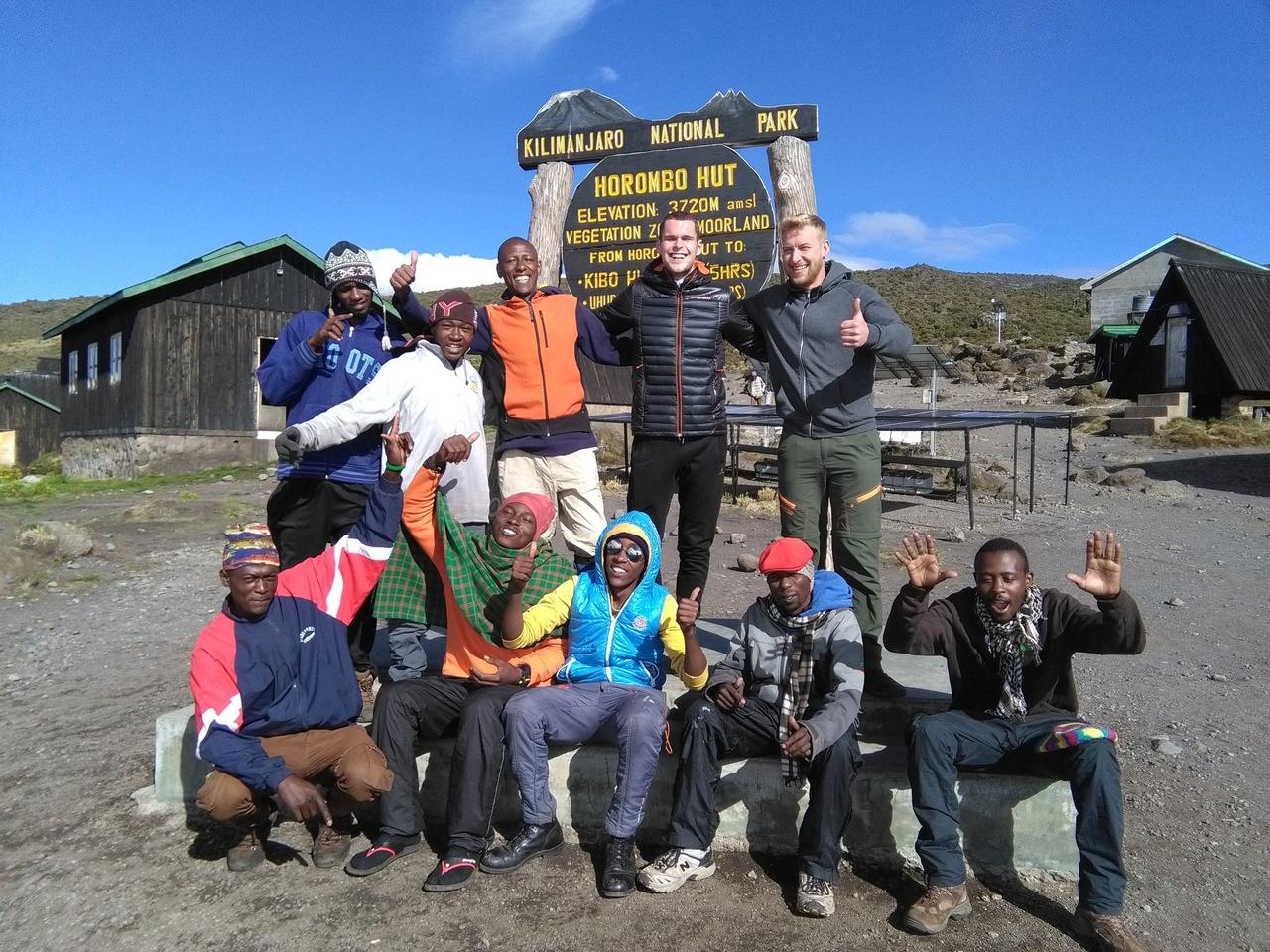
Photo: Twende Africa Tours / Pexels
Four steps
- On the first day
Ask for the crew list: every name and every role. Count the crew at the gate once the bags are weighed.
- Before the last day
Agree the amounts as a group and pool the money. Ask the lead guide how the company shares tips.
- At the farewell
Hand each person an envelope, or give them to the guides and a porters’ representative, and say the amounts out loud.
- Afterwards
Ask for a signed list of who received what. Keep it, in case a crew member asks later.
Four ways it is done
- An envelope for each personThe clearest for everyone, and KPAP’s advice when a company has no procedure of its own. You need many small notes.
- One envelope per roleOne for the guides and cook, one for the porters, shared out by representatives the crew choose.
- Everything to the lead guideSimple, and fair only if the total and every share are announced to the whole crew, in English and Swahili.
- Through the officeYou fill in a tip form at the last camp; the company pays the tips with the wages after the climb, in cash or into the crew’s bank accounts.
Sometimes people who never worked on the climb turn up at the farewell to share the tips. The crew list protects the porters who carried your bags.
Cash: Dollars or shillings
Tips are paid in cash. Most crews still count in US dollars; Tanzanian shillings spare them the exchange.
US dollars
Clean, untorn notes printed in 2013 or later: older or damaged notes are often refused. Large notes change at a better rate; small ones make single envelopes possible, so bring some of each.
Shillings
The largest note is TZS 10,000 (about $3.80), so TZS 2,138,000 for a group of two makes a thick stack. Cash machines in Moshi and Arusha pay out about TZS 400,000 ($150) at a time.
Euros and cards
Euros and pounds are hard for the crew to change, and few companies pass on card payments. Bring the cash with you, or draw shillings in town.
On the mountain
Many companies ask you to leave the tip money in the hotel safe and hand it over after the climb. Ask yours where the farewell takes place.
Fair pay: What porters and guides earn
Tanzania has no binding minimum wage for mountain crews. The national wage order of 2026 lists a tour guide at TZS 12,308 a day and a luggage porter at TZS 8,654; the rates that porters’ organisations have agreed with the government and the tour operators were never published as law. So pay depends on the company.
Day wages
| Porter, at KPAP’s partner companies (since December 2024) | TZS 25,000$9.49 |
|---|---|
| Cook or assistant guide, at KPAP’s partners | TZS 30,000$11.39 |
| Guide, at KPAP’s partners | TZS 40,000$15.19 |
| Porter, the lowest pay reported elsewhere | TZS 10,000$3.80 |
| Luggage porter, national wage order | TZS 8,654$3.29 |
A rise for porters to TZS 35,000 a day (about $13) was expected in 2026 but has not come into force.
In a good season of about 14 week-long climbs, wage and tips at these rates add up to roughly $1,500–$1,900 a year.
Photo: Tom Cleary / Unsplash
Who they are
Most porters are men from the villages on the mountain’s slopes, in their twenties and thirties: in a study of 384 porters the average age was 31, and 64% had been to primary school only. Porters’ leaders put their number at 16,000–20,000 on Kilimanjaro and Meru. More women now work as porters and guides. Many guides started as porters, became assistant guides and trained at the wildlife college in Mweka.
- Park fees$956
- Crew wages$400
- Food, tents, transport, hotels, the office, taxes and profit$1,450
- Your tips, on top$330–$480
A high price does not prove fair pay; a very low one makes it unlikely. Park fees alone come to $956 per climber for seven days.What a climb costs
Treatment: How a crew should be treated
These are the standards of KPAP’s partner programme and the International Porter Protection Group. Ask about them before you book: on the mountain you will see most of them for yourself.
A fair wage
Paid in full within two days of coming down, whatever the tips.
A fair load
At most 20 kg of gear per porter, personal kit on top; the park’s limit is 25 kg in all. Bags are weighed at the gate.
Three meals a day
Proper portions, paid for by the company.
A tent to sleep in
With a groundsheet and room to lie down. The mess tent is not a bedroom.
Warm clothing
Boots, a waterproof jacket, gloves, a hat and a sleeping bag for the cold high camps.
Care when ill
A sick or injured porter goes down with someone, and the company pays for treatment.
Tips that arrive
Every crew member receives a fair share, with the amounts announced.
No fee for work
Nobody pays a guide, or anyone else, to get a place on a crew.
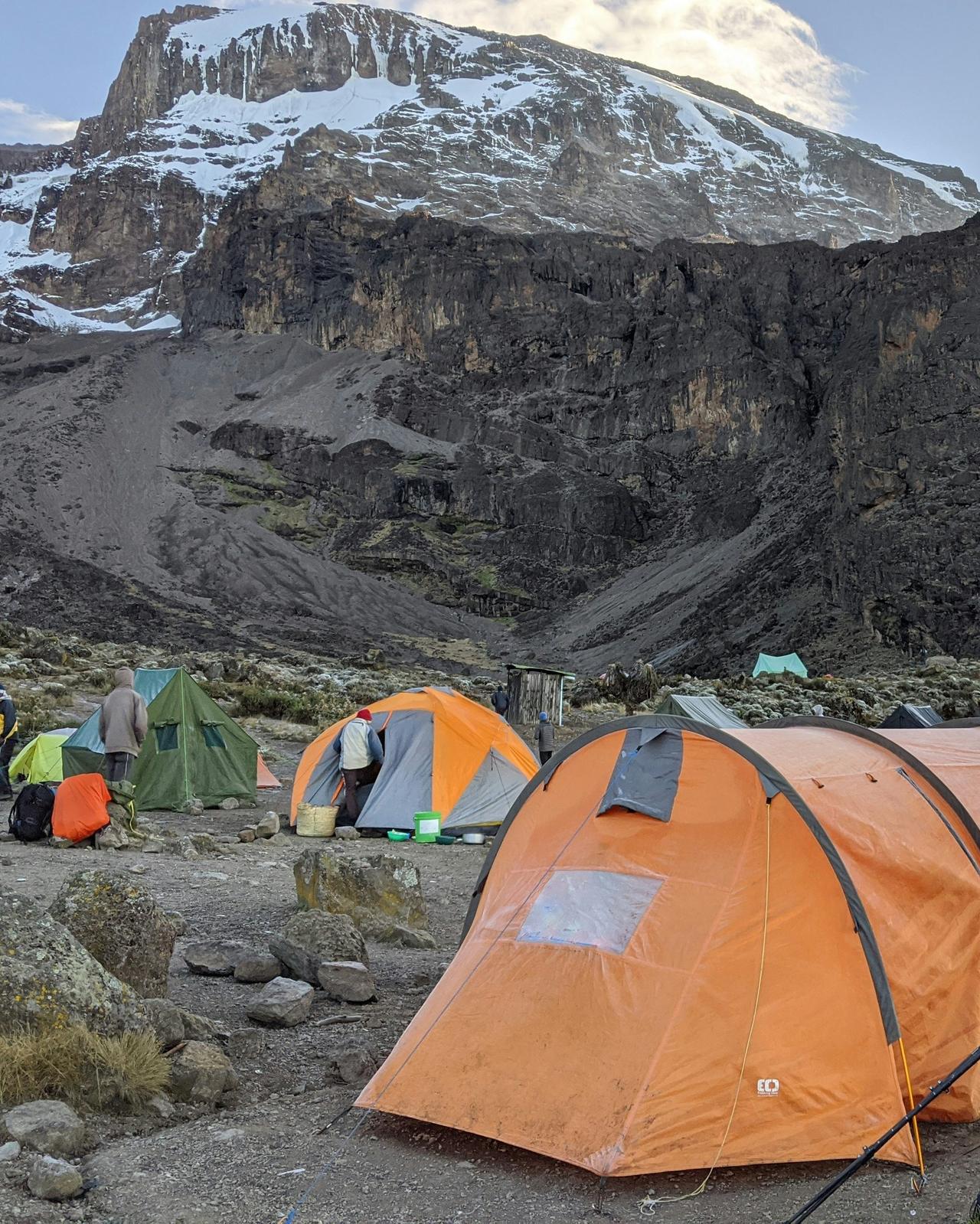
Photo: Twende Africa Tours / Unsplash
Before you book: Finding a fair operator
A brochure will not tell you what the crew are paid, but you can ask. A company that treats its crew well answers these questions readily, in writing.
Ask
- What does a porter, a cook and a guide earn a day, in shillings, and is it paid in full whatever the tips?
- When and how are wages paid: within two days, to each person, and not through the lead guide?
- How many porters come with our group, and what does each one carry?
- Where do the porters sleep, and what do they eat?
- Do the porters have warm clothing and boots, and does anyone check before the climb?
- What happens if a porter falls ill?
- How are tips shared, and will we get the crew list?
- Are you a partner of KPAP this season?
Warning signs
- A seven-day climb priced close to the park fees alone ($956).
- “Tips included”, with no word on what the crew are paid.
- Wages for the whole crew handed to the lead guide.
- No crew list, or more people at the farewell than on the trail.
- Porters sleeping in the mess tent, or eating once a day.
About KPAP
The Kilimanjaro Porters Assistance Project, run by a non-profit in Moshi, follows how porters are treated on the climbs of its partner companies: 176 at the end of 2025, 63 of them Tanzanian operators and 113 travel companies abroad that book through them. Taking part is voluntary and free. It is a useful check, not a licence: look for the company on the current partner list.
The partner listAfter the climb
Tell KPAP how your crew was treated in its climbers’ survey, whoever you climbed with. Concerns about a licensed company can also go to Kilimanjaro National Park.
The climbers’ surveySpecial cases: When it is not so simple
You turn back early
Tip for the days you booked. The crew kept those days free for you, and some of them walked you down.
A porter went down with someone
Include them in full: whoever took a climber down has earned it, and is easily forgotten at the farewell.
The service was poor
Tell the lead guide or the company the same day. Tip less if you must, but don’t cut the porters’ tips for a guide’s failings.
You climb on your own
You tip a whole crew by yourself: about $450–$640 for seven days.
You climb in a large group
Each climber pays less: about $210–$320 each in a group of eight.
You take the Marangu route
Huts need fewer porters, so the total is lower: about $190–$270 each for two climbers over five days.
Extra crew
A toilet porter or a summit porter earns a tip of their own, about $8–$12 a day.
Someone asks for tips early
Tips belong at the end, in front of the whole crew. Mention any early request to the company.
Giving gear
Warm jackets, boots in good condition, gloves, hats, head torches and sleeping bags are welcome. Give them to the person directly, after the tips: gear is a gift on top, never instead of cash. KPAP also lends warm clothing to porters for free.
Questions: Tipping on Kilimanjaro, answered
How much should I tip on Kilimanjaro?
For a seven-day climb, plan on about $330–$480 per climber if two of you climb together, $230–$340 each in a group of four and $450–$640 on your own. The group gives each crew member a daily amount: about $20–$25 for the lead guide, $12–$15 for each assistant guide, $12–$15 for the cook and $6–$10 for each porter.
How much do I tip each porter and the guide?
From the whole group, about $6–$10 a day for each porter ($42–$70 for a seven-day climb) and $20–$25 a day for the lead guide. Each assistant guide and the cook receive $12–$15 a day.
Are the amounts per climber or per group?
Per group. The daily amounts are what each crew member receives from the whole group; the climbers then share the total between them.
Is tipping compulsory?
No, but it is expected: tips are a large part of the crew’s income, and the daily rates assume them. If the service was poor, tell the company and tip less rather than nothing.
What if I don’t reach the summit?
Tip for the climb you booked. The crew’s days were reserved for you, and some of them may have walked you down.
Can I tip in euros, by card or in advance?
Bring US dollars or Tanzanian shillings in cash: euros and pounds are hard for the crew to change, and most companies do not take tips by card. A few pass tips on with the wages after the climb; ask yours.
Should I give all the tips to the lead guide?
Only if the total and every share are announced in front of the whole crew and written down. Otherwise hand each person an envelope of their own.
How much do Kilimanjaro porters earn?
At KPAP’s partner companies at least TZS 25,000 a day (about $9.49) since December 2024; elsewhere as little as TZS 10,000. Tips from the group add about $6–$10 a day.
Is it ethical to climb with porters?
Yes, when they are paid and treated fairly: portering is one of the main sources of work around the mountain, and porters’ organisations argue for the jobs. Choose an operator that answers the questions above, and tip well.
What is KPAP?
The Kilimanjaro Porters Assistance Project, a non-profit programme in Moshi that follows how porters are treated on its partner companies’ climbs, lends porters warm clothing and runs free classes. Taking part is voluntary; it is not a licence.
Sources
Updated
Tip amounts come from 19 tipping guides published by operators and guide writers in 2024–2026; KPAP has published no amounts since 2022. Wages and standards come from KPAP, the national wage order and the Tanzanian press. Crew sizes, the totals per climber and a porter’s week are calculated from these, at the exchange rates of October 15, 2026.
- Porters’ organisations
- KPAP: porter treatment and tipping guidelines
- KPAP: our impact
- KPAP: good practice areas for partner companies
- IMEC: Partner for Responsible Travel companies
- IMEC: annual report 2025 (PDF)
- KPAP: Kilimanjaro climbers’ survey
- International Porter Protection Group: five guidelines (archived)
- Tipping guides
- Ultimate Kilimanjaro: tipping
- Follow Alice: Kilimanjaro tipping
- Duma Explorer: tipping guide
- Monkey Adventures: Kilimanjaro tipping
- Kilimanjaro Brothers: tipping guideline
- Ascend Tanzania: tipping
- Jaynevy Tours: tipping guide
- Footslopes Tours: tipping
- Gladys Adventure: trekking
- Legend Expeditions: tipping on Kilimanjaro
- Altezza Travel: tipping culture
- Kandoo Adventures: Lemosho route
- Much Better Adventures: the full cost breakdown
- G Adventures: Machame route
- Allibert Trekking: Kilimandjaro, Machame
- Nomade Aventure: ascension du Kilimandjaro
- Climb Kilimanjaro Guide: tipping
- BookATrekking: Kilimanjaro tipping
- Helen in Wonderlust: tipping on Kilimanjaro
- Henry Stedman: tipping
- Wages and rules
- Daily News (2024): porters celebrate increased wages
- Daily News (2026): the mandate of KRTO
- The Citizen (2025): Kilimanjaro’s unsung heroes
- Anadolu Agency (2021): porters demand better wages
- Clyde & Co (2026): Tanzania’s new wage order
- Mountains National Parks Regulations, GN 191 of 2003 (PDF)
- Kilimanjaro National Park: visitor brochure (PDF)
- Studies
- Mitchell, Keane and Laidlaw (2009), ODI: package tourism in northern Tanzania (PDF)
- Lyamuya et al. (2017), East African Health Research Journal: Kilimanjaro porters
- Peaty (2012), Ritsumeikan: Kilimanjaro tourism and local porters (PDF)